You wash your hair expecting your scalp to feel fresh, clean and comfortable.
Instead, not long after stepping out of the shower, you notice it.
The itch.
Maybe your scalp feels tight. Maybe it feels dry. Perhaps you're noticing flakes. Or maybe you find yourself scratching your scalp even though you've only just washed your hair.
If you've ever wondered "why is my scalp itchy after washing my hair?", you're certainly not alone.
An itchy scalp after shampooing can happen for several reasons. Sometimes it can be as simple as the way you're washing your hair or the products you're using. Other times, persistent itching can be associated with a scalp condition that may need professional advice.
The American Academy of Dermatology notes that reactions to haircare products, shampoo residue and dandruff are among the potential causes of an itchy scalp.
So before you reach for another product, it is worth looking at what your scalp might be trying to tell you.
Why Does My Scalp Itch After Washing My Hair?
There isn't one universal reason.
Your scalp is skin, and just like the skin on your face, it has its own barrier, natural oils and microbiome.
Washing removes sweat, oil, styling products and everyday buildup. But your cleansing routine also exposes your scalp to shampoo, water, heat and friction.
If your scalp feels itchy after washing, some of the most common things to consider include:
- Your shampoo
- Over-cleansing
- Hot water
- Shampoo or conditioner residue
- Fragrance or another ingredient your scalp doesn't like
- Product buildup
- Dryness
- Dandruff
- An underlying scalp condition
Let's look at these more closely.
1. Your Shampoo Could Be Leaving Your Scalp Feeling Stripped
There is a difference between clean and stripped.
You don't necessarily need your scalp to feel squeaky clean after every wash.
If your scalp regularly feels tight, dry or uncomfortable immediately after shampooing, look at the cleanser you're using and how you're using it.
This is especially relevant if you're already prone to a dry or sensitive scalp.
At AMPERNA®, this is one reason we approach scalp cleansing in much the same way we approach facial cleansing.
The aim is to cleanse effectively without unnecessarily overwhelming the skin underneath.
Our Cleanse & Rebalance Dermal Care Shampoo [DERMACLEANSE] is a fragrance-free and sulfate-free shampoo developed to cleanse the hair and scalp without leaving them feeling stripped.
It also incorporates AMPERNA®'s prebiotic and postbiotic approach to scalp care and is suitable for sensitive scalps.
Think of it as:
A facial cleanser for your scalp.

2. You Might Be Washing Your Hair Too Aggressively
Sometimes the issue isn't simply what you're washing with.
It's how you're washing.
When your scalp feels oily or dirty, it can be tempting to scrub harder.
But more pressure doesn't necessarily equal a cleaner scalp.
Aggressively scratching the scalp with your fingernails or repeatedly scrubbing the same area can leave the skin feeling uncomfortable.
Instead, concentrate shampoo around your scalp and roots, where oil, sweat and product buildup tend to accumulate.
Use your fingertips to gently massage the shampoo through your scalp before rinsing thoroughly.
Your lengths generally don't need the same degree of cleansing. Shampoo will naturally travel through them as you rinse.
We explore this and other common behaviours in our guide to 10 everyday hair habits that could be affecting your scalp health.
3. Your Shower Might Be Too Hot
A steaming-hot shower might feel fantastic, particularly in winter.
Your scalp may not appreciate it quite as much.
If you already experience a dry, tight or sensitive scalp after washing, try turning the temperature down.
You don't need freezing cold water.
Simply switching from very hot water to comfortably warm water is an easy experiment.
This is particularly worth trying if your scalp feels comfortable before washing but noticeably dry or itchy immediately afterwards.
4. You Might Not Be Rinsing Your Shampoo Out Properly
This one is surprisingly easy to overlook.
If shampoo isn't rinsed thoroughly from your scalp, the residue left behind may contribute to irritation.
The American Academy of Dermatology specifically identifies inadequately rinsed shampoo as one possible reason for an itchy, dry or flaky scalp.
If you have very thick, curly or long hair, sectioning your hair while rinsing may help water reach the scalp properly.
Pay particular attention to:
The crown.
Behind the ears.
The nape of the neck.
The back of the head.
Take your time.
Sometimes the solution to itchy scalp after shampooing isn't adding another product.
It's making sure the first one has actually been washed away.
5. Your Scalp May Be Reacting to a Haircare Product
Shampoo isn't the only product that comes into contact with your scalp.
Think about everything you might use during an average week:
Shampoo.
Conditioner.
Hair masks.
Dry shampoo.
Hair spray.
Styling creams.
Gels.
Oils.
Heat protectants.
Hair colour.
Fragrance.
That's a lot of potential contact.
The AAD notes that allergic contact dermatitis can occur in response to shampoo, conditioner and other products that touch the scalp, while hair dye is another recognised trigger.
If the itching began after introducing a new product, that timing is worth paying attention to.
And if you're experiencing a significant rash, swelling, burning or persistent symptoms, seek advice from a healthcare professional rather than continuing to experiment with different cosmetic products.
6. Product Buildup Could Be Part of the Problem
There is another side to scalp cleansing.
You don't want to unnecessarily strip the scalp, but you also need to remove what accumulates on it.
Dry shampoo, styling products, oils, sweat and sebum can all build up between washes.
If you're regularly adding products without effectively cleansing your scalp, it may start to feel uncomfortable.
This is why our philosophy isn't:
Wash your hair as little as possible.
And it isn't:
Wash it every day.
It's:
Wash according to what your scalp actually needs.
Someone who exercises daily and regularly uses styling products may have very different cleansing needs from someone with a naturally dry scalp who rarely uses styling products.
There is no perfect wash-day number for everyone.
You might also like to try a scalp massage brush!
7. Is It an Itchy Dry Scalp or Dandruff?
This distinction matters.
A dry scalp and dandruff aren't necessarily the same thing, even though both can involve itching and visible flakes.
Dandruff is commonly associated with seborrheic dermatitis, which can cause itching, flaking and greasy or scaly areas of the scalp.
A scalp that simply feels dry or tight after washing may need a very different approach.
This is why throwing an anti-dandruff product at every flaky scalp isn't necessarily the answer.
We've written a complete guide to dry scalp vs dandruff and how to tell the difference.
If you're noticing persistent or significant flaking, redness, scales or intense itching, speak to a healthcare professional for an appropriate diagnosis.

8. Overwashing Could Be Leaving Your Scalp Feeling Dry
If your scalp feels fine before washing but itchy, dry or tight after shampooing, think about how often you're cleansing.
There isn't one correct frequency.
For some people, frequent washing works perfectly well.
For others, particularly those with a naturally dry or sensitive scalp, frequent cleansing may leave the scalp feeling less comfortable.
Rather than following a rule you saw online, look at your own scalp.
Ask yourself:
Does my scalp feel better before or after I wash it?
Does it feel tight immediately afterwards?
How quickly does it become oily?
Am I washing because my scalp actually needs it, or simply because it's part of my routine?
Am I using lots of dry shampoo to extend the time between washes?
Your answers can tell you far more than an arbitrary wash schedule.
9. Your Conditioner Might Be Getting Onto Your Scalp
Conditioner is generally designed primarily for your hair.
If your scalp becomes itchy after washing, consider where you're applying it.
Unless your particular conditioner is designed for scalp application, concentrate it through the mid-lengths and ends rather than coating the scalp.
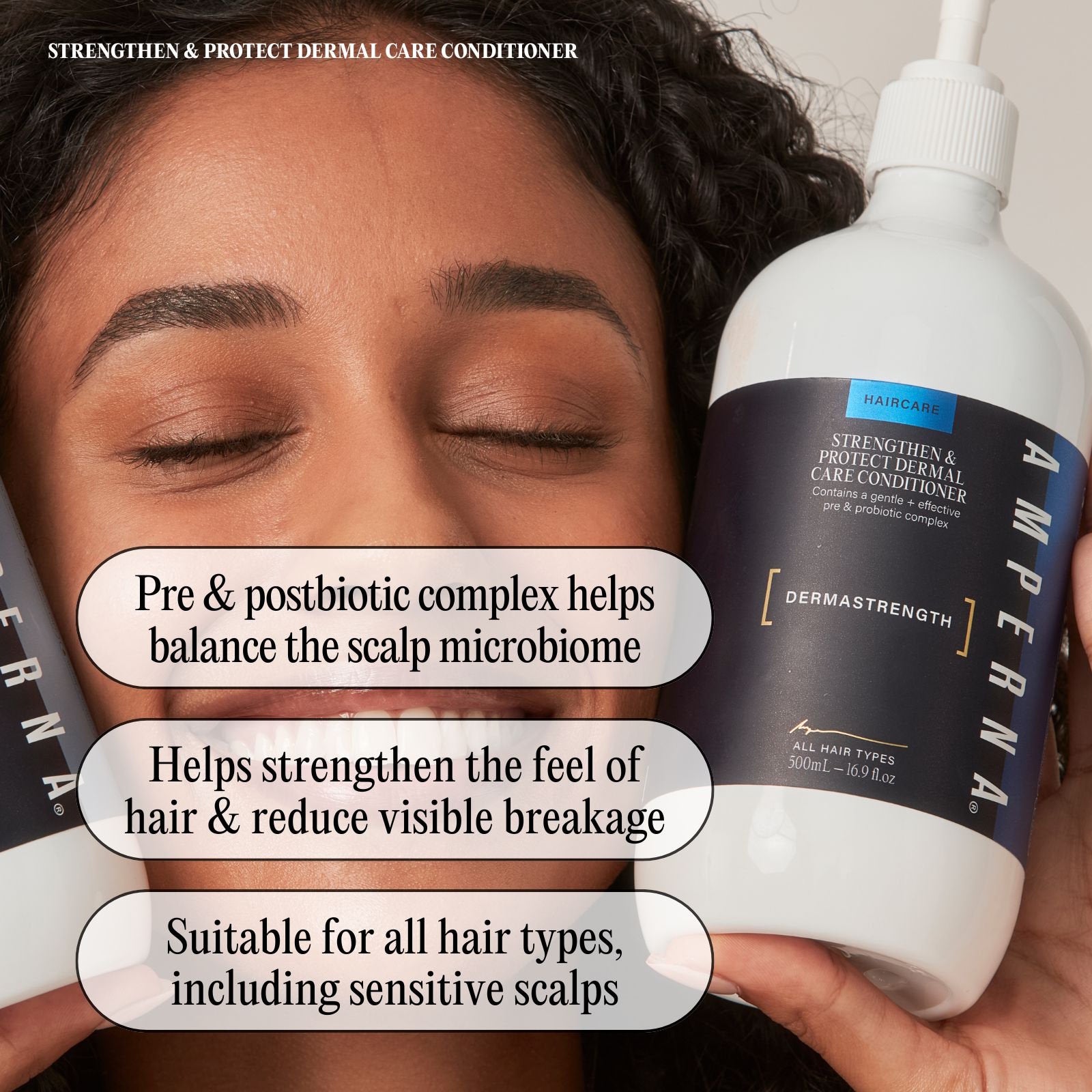
Our Strengthen & Protect Dermal Care Conditioner [DERMASTRENGTH] is designed to follow DERMACLEANSE as part of the AMPERNA® wash-day routine, helping hydrate, soften and condition the hair.
Scalp gets the shampoo.
Lengths and ends get the conditioner.
Simple.
10. Your Scalp Barrier Deserves Attention Too
We talk a lot about the skin barrier in facial skincare.
But your face isn't where your skin stops.
Your scalp is skin too.
It has its own protective barrier and is home to a community of microorganisms collectively known as the scalp microbiome.
Your scalp is also regularly exposed to cleansing, sweat, oil, styling products, environmental impurities and hair colour.
That's why AMPERNA® takes a skin-first approach to haircare.
If you'd like to understand this concept in more detail, we've written about the difference between a balanced and unbalanced scalp microbiome, as well as what postbiotics are in haircare and what they do.

What Should I Use If My Scalp Feels Itchy After Washing?
First, think about the possible cause.
If you have a diagnosed scalp condition, significant inflammation, a rash or persistent itching, appropriate medical care is more important than simply changing cosmetic products.
But if you're dealing with a scalp that tends to feel dry, tight, sensitive or uncomfortable after ordinary washing, consider simplifying your routine.
At AMPERNA®, our scalp-first routine is:
SUPPORT → CLEANSE → CONDITION
Step 1: Support With [DERMAFIX]
Before wash day, give the skin underneath your hair its own dedicated skincare step.
Scalp & Hair Care Serum [DERMAFIX] is a lightweight overnight or pre-wash scalp serum formulated with prebiotic and postbiotic technology, barrier-supporting ingredients and a vitamin-rich complex.
The formula includes Alpha-Glucan Oligosaccharide, Lactobacillus, Niacinamide, Glycerin and Vitamins B3, B5, B6, C and E.
It has been developed to help replenish hydration, maintain scalp comfort and support the scalp's natural protective barrier.
Apply DERMAFIX directly to your scalp and gently massage it in.
Leave it overnight, or use it as a pre-wash treatment before shampooing.
You can learn more about the thinking behind it in Introducing AMPERNA® Scalp & Hair Care Serum [DERMAFIX].
Step 2: Cleanse With DERMACLEANSE
Follow with Cleanse & Rebalance Dermal Care Shampoo [DERMACLEANSE].
The fragrance-free and sulfate-free formula gently removes everyday impurities, oil and product buildup while helping maintain scalp comfort.
It contains AMPERNA®'s prebiotic and postbiotic technology alongside hydrating ingredients including Glycerin, Hydrolysed Hyaluronic Acid and Sodium Hyaluronate.
Apply to wet hair and concentrate your cleansing at the scalp.
Massage gently with your fingertips.
Rinse thoroughly.
Repeat only if needed.
Step 3: Condition With [DERMASTRENGTH]
Finish with Strengthen & Protect Dermal Care Conditioner [DERMASTRENGTH].
Focus primarily on your hair lengths and ends to hydrate, detangle and soften the hair.
Together, the three steps create a straightforward scalp-to-strands routine:
DERMAFIX → DERMACLEANSE → DERMASTRENGTH
No complicated scalp routine required.
EXPLORE AMPERNA® SCALP + HAIR CARE →
How Can I Stop My Scalp Feeling Itchy After Shampooing?
If you're dealing with everyday dryness or discomfort rather than a diagnosed scalp condition, start with the basics.
Use a gentle shampoo appropriate for your scalp. Avoid unnecessarily hot water. Massage rather than scratch. Rinse your shampoo thoroughly. Be mindful of how much dry shampoo and styling product you're using. Avoid constantly switching products. And pay attention to how frequently your individual scalp actually needs cleansing.
Most importantly:
Don't assume that a harsher cleanse is always a better cleanse.
Your scalp should feel clean after washing.
It doesn't need to feel stripped.
Why Does My Scalp Itch Straight After Washing?
The timing can sometimes provide a useful clue.
If itching consistently starts immediately after shampooing, consider the products and washing process first.
Did you introduce a new shampoo?
Was the shower particularly hot?
Did you rinse thoroughly?
Did you aggressively scrub?
Did hair colour or another treatment touch your scalp?
Does your scalp feel tight as well as itchy?
If it happens every time you use a particular product, stop using that product and see whether the problem settles. Persistent symptoms or an accompanying rash warrant professional assessment. The AAD specifically advises that reactions to haircare products can cause an itchy rash and that a dermatologist can help identify the culprit when it isn't obvious.
Why Is My Scalp Itchy but I Don't Have Dandruff?
Itchy scalp doesn't automatically mean dandruff.
Possible explanations include simple dryness, irritation from a haircare product, inadequate rinsing, contact dermatitis and other scalp conditions.
Look at the complete picture rather than focusing on the itch alone.
Is there flaking?
Redness?
A rash?
Bumps?
Greasy scales?
Dryness?
Burning?
Hair shedding?
And is it temporary, or does it keep coming back?
These details can help a healthcare professional distinguish between simple dryness and something requiring specific treatment.

Can Dry Shampoo Make My Scalp Itchy?
Dry shampoo can be useful between washes, but remember what it actually does.
It doesn't wash your scalp.
It helps absorb oil.
If you're repeatedly applying dry shampoo alongside styling products, sweat and natural oils without adequately cleansing your scalp, buildup can accumulate.
That doesn't mean you have to stop using dry shampoo altogether.
Just treat it as a styling product rather than a replacement for washing.
Our article on 10 everyday hair habits that could be affecting your scalp health goes into this in more detail.
When Should I Get an Itchy Scalp Checked?
An occasional itchy scalp isn't necessarily unusual.
But don't keep experimenting with cosmetic products indefinitely if something clearly isn't right.
Consider speaking with a doctor or dermatologist if the itching is persistent, severe, worsening or accompanied by significant redness, a rash, sores, thick scaling, swelling, pain or noticeable hair loss.
Conditions such as seborrheic dermatitis can cause persistent itching and flaking and may require specific treatment rather than ordinary cosmetic scalp care.
Start Thinking About Your Scalp Like Skin
We spend a lot of time thinking about the hair we can see.
Is it shiny?
Soft?
Smooth?
Frizzy?
Dry?
But underneath all of it is your scalp.
And if your scalp is itchy after washing your hair, don't automatically assume the answer is to wash harder, use more products or add another treatment.
Look at the fundamentals first.
How are you cleansing?
What are you cleansing with?
Are you rinsing thoroughly?
How does your scalp feel immediately afterwards?
What else are you applying between washes?
Then build your routine from there.
At AMPERNA®, we believe healthy-looking hair starts by caring for the skin underneath it.
Your scalp is skin. Treat it like skin.
EXPLORE AMPERNA® SCALP + HAIR CARE →
Frequently Asked Questions
Why is my scalp itchy after I wash my hair?
An itchy scalp after washing can have several potential causes, including dryness, shampoo residue, sensitivity to a haircare product, dandruff or another scalp condition. How you wash your hair, the water temperature and the products you use may also influence how your scalp feels.
Why does shampoo make my scalp itchy?
Some people may be sensitive or allergic to an ingredient in a shampoo or another haircare product. Shampoo that isn't rinsed away thoroughly can also irritate the scalp. If one particular product repeatedly causes itching or a rash, discontinue it and seek professional advice if symptoms persist.
Why is my scalp itchy after washing but there are no flakes?
Itching doesn't always come with flakes. Dryness, irritation, product sensitivity, shampoo residue and other scalp conditions can cause itching without obvious dandruff.
Why does my scalp feel tight after shampooing?
A tight feeling after washing may be associated with scalp dryness or your cleansing routine. Consider your shampoo, water temperature, washing frequency and whether you're aggressively cleansing your scalp.
Is an itchy scalp always dandruff?
No. Dandruff is one possible cause of an itchy scalp, but product reactions, dryness and a number of scalp conditions can also cause itching.
Should I wash my hair again if my scalp is itchy?
Not necessarily. If you think shampoo or another product hasn't been rinsed away properly, thoroughly rinsing may help. But repeatedly shampooing an already dry or uncomfortable scalp may not be the best response. Consider why your scalp is itching first.
What shampoo should I use for a sensitive, itchy scalp?
Look at the complete formulation rather than chasing one ingredient. If your scalp tends to feel dry or sensitive after washing, you may prefer a gentle, fragrance-free shampoo designed with sensitive scalps in mind. AMPERNA® [DERMACLEANSE] is fragrance-free, sulfate-free and formulated with prebiotic and postbiotic technology.