Dry scalp and dandruff can look surprisingly similar, but they’re not necessarily the same thing.
Both can involve flakes. Both can leave you noticing white particles in your hair or on your clothing. And both may be accompanied by an itchy or uncomfortable-feeling scalp.
But the reasons behind the flaking can be different, which is why reaching for the first “anti-dandruff” product you see may not always be the right answer.
If your scalp simply feels dry, tight or uncomfortable, it may be worth looking at something much more basic first:
What are you washing your scalp with?
At AMPERNA®, we believe your scalp deserves the same consideration as the skin on your face.
Because your scalp is skin too.
Dry Scalp vs Dandruff: The Quick Answer
A dry scalp generally occurs when the skin on your scalp lacks adequate moisture or is being exposed to factors that leave it feeling dry or stripped.
Dandruff, on the other hand, is commonly associated with increased shedding of scalp skin and can be related to seborrheic dermatitis, an inflammatory skin condition associated with oily areas of the skin and the yeast Malassezia.
The flakes can look different too.
Dry scalp may involve:
- Smaller, dry-looking flakes
- A tight or dry feeling
- Mild itchiness
- Dryness elsewhere on the skin
- A scalp that feels stripped after shampooing
Dandruff may involve:
- More persistent flaking
- Larger flakes
- White or yellowish-looking scale
- An oily or greasy scalp
- Itching
- Redness or irritation
But appearance alone isn't enough to diagnose what's happening.
If your flaking is persistent, severe, inflamed, very itchy or isn't improving, speak to your doctor or dermatologist rather than trying to diagnose it yourself.
What Causes a Dry Scalp?
Sometimes the simplest explanation is the right place to start.
Your scalp is covered in skin, complete with its own skin barrier and microbiome.
Just like the skin on your face, it can feel dry or uncomfortable when exposed to environmental conditions or a routine that doesn't suit it.
Potential contributors to a dry-feeling scalp include:
Harsh Cleansing
Some people love the squeaky-clean feeling after shampooing.
Your scalp may not.
Strong cleansing products or frequently using products that leave the scalp feeling stripped can contribute to dryness and discomfort.
Can haircare contribute to breakouts?

Washing Too Frequently
How often you need to wash your hair varies according to your scalp, hair type, lifestyle and product use.
But if your scalp consistently feels tight or dry immediately after washing, it's worth looking at your wash routine.
Hot Water
That steaming-hot shower might feel amazing, but very hot water can leave skin feeling dry.
Your scalp is no exception.
Try washing with lukewarm rather than very hot water.
Weather + Environment
Cold weather, low humidity, heating and air conditioning can all influence how dry your skin feels.
If the skin on your face and body suddenly feels drier at the same time as your scalp, your environment may be part of the picture.
Product Buildup
Sometimes scalp discomfort isn't simply about dryness.
Dry shampoo, hairspray, styling creams, oils and other products can accumulate on the scalp.
This is why finding the right balance between cleansing thoroughly and cleansing gently matters.
What Causes Dandruff?
Dandruff is more complicated than simply having a dry scalp.
It is commonly associated with seborrheic dermatitis, which can affect areas with greater sebaceous gland activity, including the scalp, eyebrows, ears and parts of the face.
The scalp microbiome also contains Malassezia, a type of yeast naturally found on human skin. Its relationship with sebum, the skin barrier and individual susceptibility is part of the dandruff picture.
This is important because it means:
Dandruff isn't necessarily caused by your scalp being too dry.
In fact, dandruff can occur on an oily scalp.
And that distinction matters when you're deciding what to do next.
For a deeper look at seborrheic dermatitis, read our guide to Seborrheic Dermatitis: Dos and Don'ts for Managing Flare-Ups.
Is Dandruff Just a Dry Scalp?
No.
This is probably the biggest misconception.
If you see flakes, it's easy to assume:
Flakes = dry skin = add moisture.
But flaking can occur for different reasons.
Dry scalp may involve a lack of moisture or a routine that's leaving your scalp feeling stripped.
Persistent dandruff can be associated with seborrheic dermatitis and other factors that require a different approach.
If you believe you have dandruff or another scalp condition, seek advice from an appropriate healthcare professional.
But if what you're experiencing is simply a dry, tight, sensitive or uncomfortable-feeling scalp, that's where looking at your everyday haircare routine makes sense.
Could Your Shampoo Be Drying Out Your Scalp?
Ask yourself:
How does my scalp actually feel after I wash my hair?
Does it feel:
Tight?
Dry?
Uncomfortable?
Itchy?
Like you can't wait several days before washing again because you're trying to relieve the sensation?
You may want to look more closely at your shampoo.
A shampoo needs to remove sweat, oil, dirt and product buildup.
But that doesn't mean your scalp needs to feel aggressively stripped afterwards.

At AMPERNA®, our philosophy is very similar to how we approach facial skincare:
Cleanse effectively without unnecessarily overwhelming the skin.
That's the thinking behind our scalp-first haircare.
What Should You Look for in a Shampoo for a Dry or Sensitive Scalp?
If your concern is simply dryness or an uncomfortable-feeling scalp, consider looking for:
Gentle Cleansing
Your shampoo should clean your hair and scalp without leaving your skin feeling excessively tight or stripped.
Hydrating Ingredients
Ingredients such as glycerin and hyaluronic acid are humectants that can help support hydration.
Microbiome-Conscious Ingredients
Your scalp has its own microbiome, just like the skin on your face.
This is one reason AMPERNA® extends its microbiome-conscious philosophy beyond facial skincare.
A Scalp-First Formulation
Don't choose your shampoo based only on how shiny it makes the lengths of your hair.
Think about the skin underneath it too.
Meet [DERMACLEANSE]: AMPERNA®'s Scalp-First Shampoo
If your concern is a scalp that simply feels dry, sensitive or uncomfortable, consider the products you're washing it with.
Cleanse & Rebalance Dermal Care Shampoo [DERMACLEANSE] was developed with the scalp in mind.
It uses gentle cleansing agents alongside hydrating and microbiome-conscious ingredients including:
Glycerin
Hydrolysed Hyaluronic Acid
Sodium Hyaluronate
Alpha-Glucan Oligosaccharide
Lactobacillus-derived ingredients
Rather than thinking about shampoo as something that only cleans your hair, [DERMACLEANSE] brings AMPERNA®'s skin-first philosophy to the scalp. AMPERNA's current DERMACARE range is formulated around gentle cleansing, scalp hydration and microbiome-conscious care.
WHY [DERMACLEANSE]?
GENTLE CLEANSING
Cleanses the scalp and hair without the goal of creating that aggressively stripped, squeaky-clean feeling.
HYDRATION
Humectants including glycerin and hyaluronic acid derivatives support scalp hydration.
MICROBIOME-CONSCIOUS
Prebiotic and postbiotic ingredients bring AMPERNA®'s microbiome-focused philosophy into haircare.
SCALP FIRST
Because healthy-looking hair starts with how you care for the skin underneath it.
Your Scalp Has a Skin Barrier Too
We talk a lot about the skin barrier when it comes to facial skincare.
But your skin doesn't suddenly stop at your hairline.
The scalp also has a barrier that helps maintain hydration and protect the skin from its external environment.
This is why the same basic principles we use for sensitive facial skin can make sense when thinking about a dry-feeling scalp:
Don't unnecessarily strip it.
Support hydration.
Pay attention to how products make your skin feel.
Keep your routine consistent.
Consider the microbiome.
If you're interested in the connection between barrier health and microbiome-conscious skincare, read What Is Microbiome Skincare? A Guide to Your Skin Microbiome.
You can also read our guide to 5 Ingredients to Avoid If You Have Sensitive Skin or Scalp. AMPERNA's existing guide discusses factors including harsh cleansing agents and fragrance when choosing products for a sensitive scalp.

What Is the Scalp Microbiome?
Your scalp is home to its own community of microorganisms.
Together, these microorganisms form the scalp microbiome.
This ecosystem exists alongside your scalp barrier, oil production and environmental exposures.
That's why modern scalp care is beginning to look increasingly like skincare.
Instead of thinking only about:
SHAMPOO → HAIR
we think:
SCALP → BARRIER → MICROBIOME → HAIR
This is central to the way AMPERNA® approaches haircare.
What About a Scalp Serum?
Your skincare routine probably doesn't end with cleanser.
So why should scalp care necessarily end with shampoo?
That's the thinking behind [DERMAFIX] Scalp + Hair Care Serum.
[DERMAFIX] takes a more targeted, skincare-inspired approach to scalp care and was developed to complement [DERMACLEANSE ]+ [DERMASTRENGTH].
Its formula combines AMPERNA®'s microbiome-conscious approach with ingredients selected to support scalp hydration and comfort, including niacinamide, calcium pantothenate, glycerin, Alpha-Glucan Oligosaccharide and Lactobacillus-derived postbiotic technology.
DERMACLEANSE + DERMAFIX
Think of them as two different jobs.
[DERMACLEANSE]
CLEANSE
Gently remove oil, sweat and buildup from the scalp and hair.
↓
[DERMAFIX]
SUPPORT
Bring a targeted, skincare-inspired step to your scalp routine.
↓
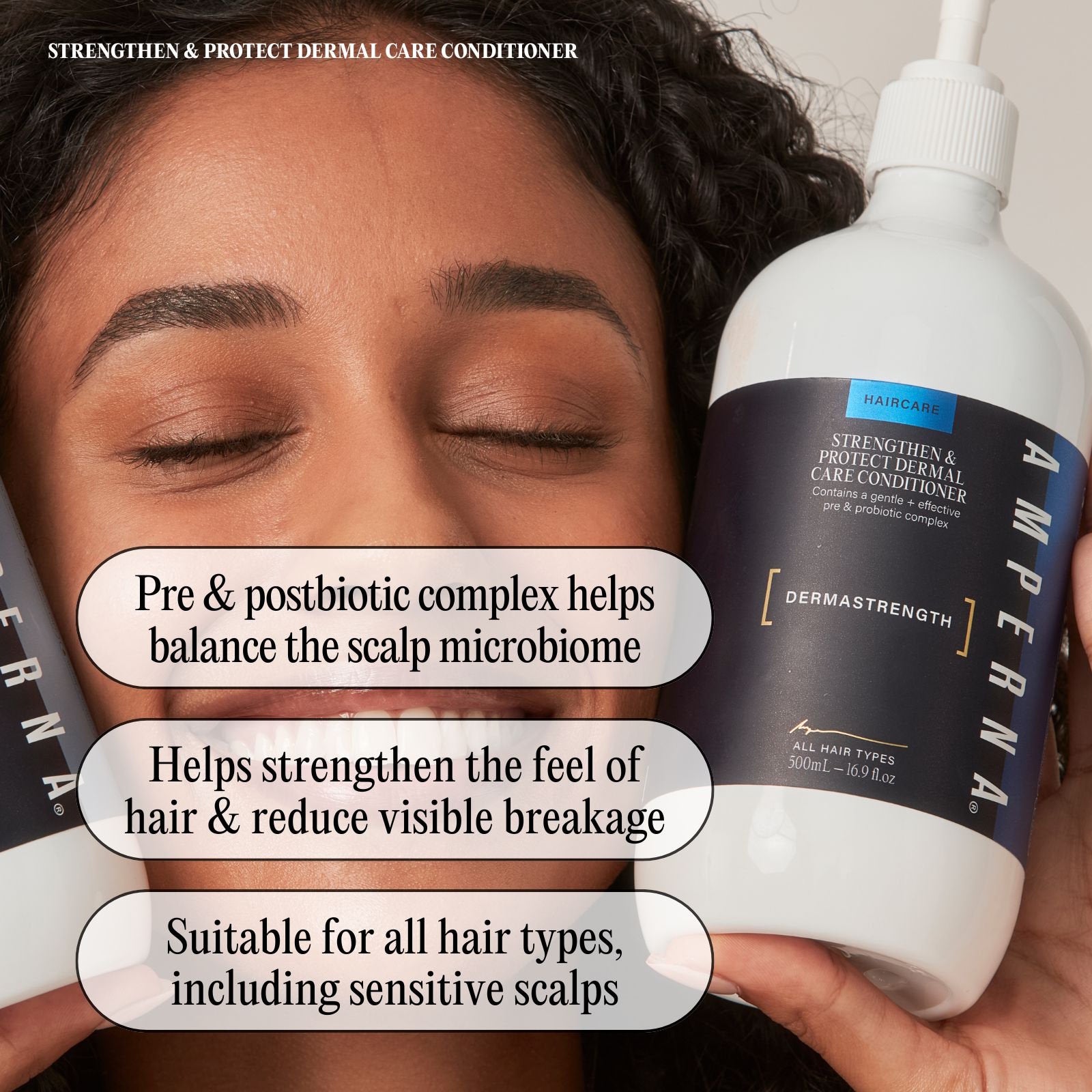
[DERMASTRENGTH]
CONDITION
Support soft, healthy-looking hair as part of your wash-day routine.
Together, they create a scalp-first approach to haircare.
EXPLORE AMPERNA® SCALP + HAIR CARE →
How to Care for a Dry-Feeling Scalp
If your scalp simply feels dry or uncomfortable and you don't have a diagnosed scalp condition, start by looking at the basics.
1. Turn Down the Temperature
Wash your hair with lukewarm rather than very hot water.
2. Look at Your Shampoo
If your scalp consistently feels stripped immediately after washing, consider whether your shampoo is suitable for you.
3. Rinse Thoroughly
Make sure shampoo and conditioner are properly rinsed from your scalp and surrounding skin.
4. Be Mindful of Styling Products
Dry shampoo, hairspray, styling creams, oils and other leave-in products can accumulate on the scalp.
5. Avoid Scratching
Scratching may make an already uncomfortable scalp feel worse.
6. Think Like You Would About Your Face
Your scalp is skin.
Give it the same consideration you give your facial skincare routine.
When Should You See a Doctor About Scalp Flaking?
Not every flaky scalp is simply dry.
Speak to your doctor, dermatologist or other appropriate healthcare professional if you're experiencing:
- Persistent or worsening flaking
- Significant redness or inflammation
- Thick, greasy or yellowish-looking scale
- Severe or persistent itching
- Pain
- Broken or weeping skin
- Hair loss you're concerned about
- Flaking affecting your eyebrows, ears, face or other areas
- Symptoms that don't improve
Conditions including seborrheic dermatitis, psoriasis, eczema and fungal infections can affect the scalp and require appropriate diagnosis and treatment.

Frequently Asked Questions About Dry Scalp vs Dandruff
How can I tell the difference between dry scalp and dandruff?
Dry scalp often involves smaller dry-looking flakes and a scalp that feels dry or tight, whereas dandruff may involve more persistent flaking, larger flakes and an oily or irritated scalp. However, symptoms can overlap, so persistent or significant flaking should be assessed by a healthcare professional.
Can you have dandruff with an oily scalp?
Yes. Dandruff isn't simply caused by a lack of moisture and can occur on an oily scalp.
Can shampoo cause a dry scalp?
A shampoo or cleansing routine that doesn't suit your skin may leave your scalp feeling dry, tight or uncomfortable. Very frequent washing, hot water and other products used on the scalp may also contribute to dryness.
Should I wash my hair less if I have a dry scalp?
Not necessarily. How frequently you should wash your hair depends on your scalp, hair type, lifestyle and the products you use. Instead of focusing solely on frequency, pay attention to how your scalp feels after washing.
Is an itchy scalp always dandruff?
No. Itchiness can have many possible causes, from dryness or product irritation to medical scalp conditions. Persistent or severe itching should be assessed by a healthcare professional.
Is dry scalp the same as seborrheic dermatitis?
No. A dry scalp is not automatically seborrheic dermatitis. Seborrheic dermatitis is an inflammatory skin condition that can cause persistent dandruff, redness, itching and greasy-looking scale.
Does AMPERNA® treat dandruff?
No. AMPERNA® haircare is cosmetic and isn't designed to treat dandruff or seborrheic dermatitis. Our scalp-first haircare is designed around gentle cleansing, hydration, microbiome-conscious ingredients and supporting a healthy-looking scalp environment.
Start With Your Scalp
If your scalp is flaky, the first step is working out whether you're dealing with simple dryness or something that needs medical attention.
If your concern is simply a scalp that feels dry, tight, sensitive or uncomfortable, take a closer look at your everyday routine.
What are you cleansing it with?
How hot is your shower?
How does your scalp feel after shampooing?
What products are building up between washes?
Because your scalp isn't just where your hair grows.
Your scalp is skin.
And at AMPERNA®, we believe it deserves to be cared for that way.
YOUR SCALP-FIRST ROUTINE
DERMAFIX → DERMACLEANSE → DERMASTRENGTH
Targeted scalp support followed by gentle cleansing + conditioning.
EXPLORE AMPERNA® SCALP + HAIR CARE →
Can haircare contribute to breakouts?
AMPERNA® products are cosmetic products and are not intended to treat, cure or prevent dandruff, seborrheic dermatitis, disease or any other skin or scalp condition. Always consult a healthcare professional for medical advice.
KEEP READING: SCALP + HAIR
Want to understand your scalp microbiome?
Balanced vs Unbalanced Scalp Microbiome →
Curious about microbiome-conscious haircare?
The Benefits of Pre + Postbiotic Haircare →
Sensitive scalp?
5 Ingredients to Avoid If You Have Sensitive Skin or Scalp →
Want to take a skincare approach to your scalp?
Meet DERMAFIX Scalp + Hair Care Serum →
New to AMPERNA® haircare?
Welcome to the DERMACARE Hair Range →