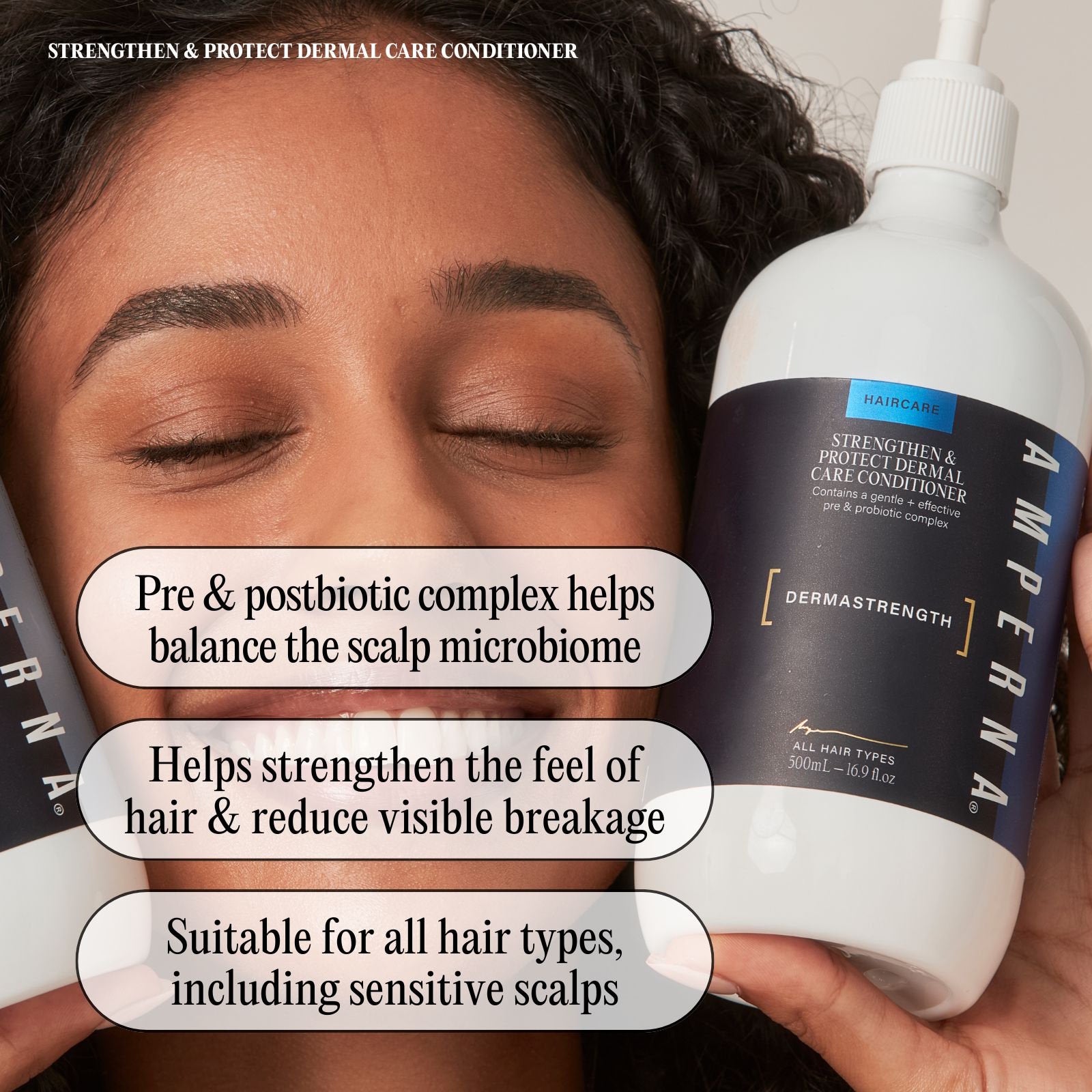
Perimenopause and Your Skin: Why Is My Skin Suddenly Changing?

Perimenopause and Your Skin: Why Is My Skin Suddenly Changing?

I thought I knew my skin.

After everything I've been through with it over the years, and after spending more than a decade developing and using AMPERNA®, I had become pretty good at understanding what my skin liked, what it didn't like and when I needed to pull things back.

Then I hit my mid-40s. And my skin started changing again. I've noticed changes in oiliness. I've had breakouts appearing in places I wasn't used to seeing them. My scalp and hair have changed too. Some weeks my skin seems completely settled and other weeks it seems to have a mind of its own.

And despite spending my working life thinking about skin, I've found myself asking the same question I know so many women ask:

Why is my skin suddenly changing?

For me, perimenopause has been another reminder that our skin isn't static.

Hormones change. Our bodies change. Our lifestyles change. And our skin can change along with them. If you're in your 40s and suddenly feel as though you don't quite recognise the skin you've known for decades, I understand how frustrating that can be.

But I also don't think the answer is to panic and completely overhaul your skincare routine. So I wanted to write this personally.

This is what I've learned about perimenopause and skin, some of the changes you may experience, what I've noticed myself, and how I'm approaching my skincare through this stage of my life.

What Is Perimenopause?

Perimenopause is the transition leading up to menopause. During this time, hormone levels can fluctuate as the body gradually moves towards menopause. You can still be having periods during perimenopause, and the transition can last for several years.

Menopause itself is reached after 12 consecutive months without a menstrual period. The hormonal changes occurring through this transition can affect more than your cycle.

They can affect your skin too.

Estrogen plays an important role in skin physiology, including collagen, elasticity, hydration and skin thickness. Research has linked declining estrogen around menopause with changes including dryness, reduced collagen and elasticity, and changes in the skin's ability to retain moisture.

But here's the important part. Not everyone's skin changes in exactly the same way. That's certainly been my experience.

Why Does Skin Change During Perimenopause?

This is where things get interesting. We tend to think about skin in fixed categories:

  • Dry skin.
  • Oily skin.
  • Sensitive skin.
  • Breakout-prone skin.

But your skin doesn't necessarily stay in one category for your entire life.

Hormonal fluctuations during perimenopause can coincide with changes in oil production and breakouts, while the menopause transition is also associated with changes in hydration, collagen and elasticity. The American Academy of Dermatology notes that some women develop adult acne around perimenopause and menopause.

So you can end up with something that seems completely contradictory. Your skin can feel drier and still break out. It can feel sensitive but also oilier in certain areas. Products you've happily used for years can suddenly feel different. And that can make figuring out what to put on your face incredibly confusing.

My skin didn't get the memo that I'm 45

One of the strangest things for me personally has been seeing changes I associated with much younger skin.

I've noticed more oiliness and I've had breakouts appearing around my chin, forehead and even my chest. At 45. Fantastic.

But I'm also noticing my skin doesn't always behave the way it did when I was younger. And that's an important distinction. My instinct isn't to suddenly start attacking every breakout with the strongest thing I can find.

I've learned enough from my skin over the years to know that when it becomes unpredictable, doing more isn't necessarily the answer. I go back to the same philosophy I built AMPERNA® around: Support the foundation first. Then decide what else your skin actually needs.

1. Your Skin May Become Drier

Dryness is one of the skin changes associated with the menopausal transition.

As estrogen declines, the skin can lose some of its ability to retain moisture. The AAD recommends mild cleansing and moisturising for menopausal skin that has become dry.

You might notice your skin feels tighter after cleansing, rougher than it used to, less supple, dehydrated by the afternoon, or simply like it needs more hydration than it once did. This is one reason I'm such a believer in paying attention to how your skin feels, rather than blindly following the same routine forever. And that's okay. Your skincare is allowed to evolve.

2. You Might Suddenly Start Breaking Out Again

This one can feel particularly unfair. You’ve finally left teenage acne behind and then, decades later, blemishes can suddenly start appearing again. Adult acne can occur for many different reasons, but hormonal fluctuations are one recognised factor, including during perimenopause and menopause. For some women, this can mean new or increased breakouts around the lower face, chin and jawline, sometimes alongside other changes such as increased oiliness, dryness or sensitivity. It can feel confusing when the skin you thought you understood suddenly starts behaving differently.

The challenge is that the products and approach you used to manage breakouts at 18 might not be what your skin needs at 40 or 50. The AAD notes that menopausal skin may become drier and thinner, and advises against unnecessarily drying acne-prone skin. That’s very aligned with how I think about skincare anyway. Rather than immediately reaching for the strongest products and trying to strip away every bit of oil, I prefer to think about the skin as a whole. Support the barrier, keep the routine gentle and consistent, and introduce targeted ingredients thoughtfully as your skin needs them.

Breakouts don't automatically mean your skin needs to be stripped.

What I've learned from my own breakouts

When I notice my skin becoming oilier or starting to break out, I’m very conscious of not immediately adding five different active products to my routine. It’s tempting. You see a spot and immediately think, right, I need to fix this. But sometimes your skin is already telling you that it’s unsettled, and throwing more products and more actives at it isn’t always the answer.

For me, this is where consistency really matters. I keep the foundation of my AMPERNA® routine in place rather than completely changing everything at once, and then adjust the more active parts of my routine depending on how my skin is behaving. Some weeks my skin needs more support, while other weeks I can comfortably introduce more targeted ingredients. I try to work with my skin rather than fight against it.

3. Your Skin May Suddenly Feel More Sensitive

Have you ever applied something you’ve used countless times before and thought, why does that suddenly feel different? Skin can become more easily irritated as it becomes drier and changes through the menopause transition. The AAD also notes that existing skin concerns such as rosacea or eczema can sometimes become more troublesome around this period. That doesn’t necessarily mean a product you’ve happily used for years has suddenly become a bad product. It may simply mean that your skin, and what it needs from your routine, has changed.

This is where I think skincare can become unnecessarily complicated. When our skin changes, we’re often encouraged to buy more. Another serum, another active, another treatment, another exfoliant, another cream. Before you know it, you’ve completely changed your routine at the same time your skin is already feeling unsettled.

Sometimes I think the better answer is actually much simpler: use less for a while. Strip your routine back to the products you know your skin is comfortable with, focus on supporting your skin barrier and give it some time before deciding what, if anything, needs to be added back in. You can always build your routine again gradually as your skin settles.

4. Your Skin May Look More Red or Flushed

Changes in skin sensitivity, combined with things like hot flushes, can also make facial redness feel much more noticeable. If you’re already someone who is prone to redness, you may find yourself becoming more aware of it during this stage of life, particularly when your skin is feeling warmer, drier or more easily unsettled.

I’ve experienced redness and rosacea-prone skin myself, so I’m particularly conscious of not overwhelming my skin when it starts behaving differently. My instinct isn’t to immediately introduce more products or stronger actives. I tend to simplify things, focus on the products I know my skin is comfortable with and give it some time to settle before making further changes.

Of course, that doesn’t mean every episode of redness is hormonal. Persistent, painful or significant changes to your skin deserve proper medical assessment rather than simply being attributed to perimenopause or menopause. But from a skincare perspective, I’ve learnt to pay attention to what my skin is telling me. When it feels like it wants less, I listen to it.

5. Your Skin May Look Duller or Less Even

Then there are the changes that aren’t necessarily about your skin feeling uncomfortable. Sometimes you simply look in the mirror and think, where did my glow go? You might start noticing uneven-looking tone, changes in texture, sun spots that seem more visible, less radiance, or a complexion that simply doesn’t look quite as bright and fresh as it once did.

Some of these changes are part of normal skin ageing and the effects of accumulated sun exposure rather than being caused by perimenopause alone. But they often become more noticeable around the same stage of life, which is why so many women suddenly start exploring ingredients like Vitamin C, retinoids, exfoliating acids and targeted brightening ingredients. There can be a real temptation to introduce everything at once in an effort to get that glow back.

I use these types of ingredients too, and I absolutely think they can have a place in your routine. But for me, there’s an important difference between using actives strategically and throwing everything at your face at once. I prefer to keep my barrier-supporting routine as the foundation, introduce targeted ingredients gradually and pay attention to how my skin responds. You don’t necessarily need more products. You need the right products, used consistently and at the right time for your skin.


6. Fine Lines and Changes in Firmness May Become More Noticeable

Estrogen and skin collagen are closely connected. Research has consistently associated the decline in estrogen around menopause with changes in collagen, skin thickness, elasticity and moisture. So yes, you may start noticing more fine lines, changes in texture or that your skin doesn’t feel quite as firm as it once did. These are normal changes, but I think we need to change the conversation around what we’re actually trying to achieve with our skincare as we get older.

I’m 45. I’m not trying to make my skin look 25. I care about my skin. Obviously, I’ve built an entire company around it. I care about brightness, texture, fine lines and uneven-looking tone, and I want to look after my skin as well as I possibly can. But I’m not interested in attacking my skin or constantly chasing stronger products in an attempt to make it look like it did decades ago.

I’m 45, and I’m completely comfortable with my skin looking 45. What I want is healthy-looking skin that feels comfortable, looks radiant and feels like the best version of my skin now. There’s a big difference between caring for your skin as it changes and constantly fighting against the natural ageing process. I’ve learned that I get much more from my skincare when I pay attention to what my skin actually needs rather than what I’m being told I should be trying to erase.

That’s how I approach AMPERNA® during perimenopause too. I keep my supportive products at the centre of my routine and introduce targeted ingredients thoughtfully depending on how my skin is behaving. Some days it needs more, some days it needs less, and I’m okay with adapting as I go. My philosophy is pretty simple: barrier first. Targeted ingredients second. Consistency always.

Why Your Old Skincare Routine Might Suddenly Stop Working

This is probably one of the biggest lessons I’ve taken from perimenopause: something can work beautifully for your skin for years and then, seemingly out of nowhere, your skin’s needs change. The cleanser you loved throughout your 30s might suddenly leave your skin feeling tight, or the moisturiser you once only reached for during winter might become something your skin wants every day.

You might find yourself needing more hydration than you used to, or noticing that your skin feels more comfortable when you use active ingredients less frequently. Products you previously used several nights a week might need to be spaced out, while gentle, supportive products become a much bigger part of your everyday routine. It doesn’t necessarily mean there’s something wrong with the products. Your skin may simply be asking for something different.

Your skincare routine is allowed to change because your skin is changing. That doesn’t mean throwing everything away and starting again. For me, it means paying attention, making small adjustments and giving my skin what it needs now, rather than continuing with a routine simply because it worked for me five or ten years ago.


Some Weeks My Skin Wants More. Other Weeks It Wants Less.

This is something I’ve become much more aware of during perimenopause. My skin isn’t necessarily the same every day of the month. There are times when it feels comfortable, balanced and happy with more targeted skincare, and other times when it seems to become more sensitive, reactive or simply needs a little more support.

On those days, my skin tells me very clearly: keep it simple, Kiri. And I listen. Rather than pushing through with an active simply because it happens to be part of my usual routine, I’m comfortable putting it aside for a few days and focusing on the products I know my skin responds well to.

That’s why I don’t believe your skincare routine needs to be completely rigid. You can still have a consistent foundation while adjusting the additional products you use depending on how your skin is behaving. For me, consistency doesn’t mean using exactly the same products every single day. It means having a reliable routine to come back to and knowing when my skin is ready for more.

This is actually one of the reasons our START → BUILD philosophy makes so much sense to me. You START with a simple, supportive foundation and then BUILD your routine gradually with more targeted ingredients when your skin is ready for them. And if your skin becomes unsettled? You can always simplify again.

My Approach: START With the Foundation

When my skin is unsettled, I don’t immediately start thinking about what else I can add. I go back to the foundation of my routine and focus on keeping things simple, consistent and supportive. For me, that means BALANCE → RESCUE → HYDRATE. Three purposeful steps, not ten.

I think there can be a tendency in skincare to assume that more products will automatically give you better results. My experience has taught me the opposite. When my skin is telling me it needs a break, I want a routine I know I can come back to without overcomplicating things.

Step 1: BALANCE

I start with our Ultra Gentle Soothing Cleanser [BALANCE]. I’ve never believed your face needs to feel squeaky clean after cleansing, especially when your skin is already feeling dry, reactive or unpredictable. That tight, stripped feeling isn’t something I’m trying to achieve with my cleansing step.

BALANCE is our gentle everyday cleanser, designed to remove everyday impurities while keeping the cleansing step simple. For me, cleansing is about preparing my skin for the rest of my routine without making it feel like I’ve taken everything away from it.

DISCOVER Ultra Gentle Soothing Cleanser [BALANCE] →

Step 2: RESCUE

Next, I use our Pro+ DS Soothing Serum [RESCUE]. RESCUE is particularly close to me because this type of supportive skincare was at the heart of why I created AMPERNA® in the first place. It combines our postbiotic complex with ingredients including niacinamide, panthenol, copper and zinc gluconates.

It’s lightweight, easy to layer and remains one of the products I come back to whenever I want to keep my routine straightforward. Rather than constantly changing everything when my skin feels unsettled, RESCUE is part of that familiar foundation I know and trust within my own routine.

DISCOVER Pro+ DS Soothing Serum [RESCUE] →

Step 3: HYDRATE

I then apply our Lightweight Soothing+ Emulsion [HYDRATE]. HYDRATE contains ceramides, cholesterol and hyaluronic acid in a lightweight moisturising formula. As my skin changes, hydration is something I’m becoming increasingly conscious of, particularly on the days when my skin feels like it needs a little more support.

At the same time, I don’t necessarily want something really heavy sitting on my face. HYDRATE gives me that everyday moisturising step while still keeping my routine feeling comfortable and light. RESCUE + HYDRATE also make up our Soothing Duo, which is often where I suggest people start when they want to simplify their AMPERNA® routine.

DISCOVER THE SOOTHING DUO →

You can also buy BALANCE, RESCUE and HYDRATE together in our Soothing Daily Edit bundle.

Then, When My Skin Is Happy, I BUILD

This is the part I think gets lost in a lot of skincare advice. Simple doesn’t have to mean basic forever. I love active skincare. I formulated active skincare, and I use active skincare. I just don’t believe every active you own needs to go on your face every night.

Once my skin feels comfortable and I’m happy with the foundation of my routine, I can start to BUILD depending on what I want to focus on. That might be brightness, uneven-looking tone, texture or the visible signs of ageing. The important thing for me is that I’m adding those targeted ingredients to a routine that is already working for my skin, rather than introducing everything at once.

When I Want Vitamin C: REPAIR

Our Pro+ Vitamin C Hyaluronic Serum [REPAIR] is where I can introduce Vitamin C and additional antioxidant support. I think of REPAIR as an addition to my foundation rather than a replacement for it. I’m not abandoning the supportive products my skin already knows just because I want to introduce a more targeted ingredient.

My morning routine might then look something like BALANCE → REPAIR → RESCUE → HYDRATE → SPF. It’s still a considered routine where every product has a purpose, but I’ve added another step because my skin is comfortable and I have a specific reason for using it.

DISCOVER Pro+ Vitamin C Hyaluronic Serum [REPAIR] →

When Brightness Is My Focus: SUPAGLOW

Uneven-looking tone and brightness are things I’m increasingly interested in for my own skin, which is where our Pro+ Advanced Brightening Serum [SUPAGLOW] comes in. SUPAGLOW combines Alpha Arbutin, Niacinamide, 3-O-Ethyl Ascorbic Acid, Oxyresveratrol and Lactic Acid in one formula.

I really like this approach because even when I’m using more targeted skincare, I still don’t want five separate brightening serums sitting in my bathroom. I want purposeful formulas that allow me to target what I’m concerned about without turning my routine into something unnecessarily complicated.

DISCOVER Pro+ Advanced Brightening Serum [SUPAGLOW] →

When I’m Ready for More Active Skincare

Texture, fine lines and the visible changes that naturally come with ageing are also things I think about. When my skin is comfortable and I feel ready to introduce something more active, this is where retinoids or retinol alternatives may become part of my routine. Again, I don’t think there needs to be a rush to introduce them simply because you’ve reached a certain age.

AMPERNA® has two different pathways. Pro+ Bio Resurfacing Retinol ALT [SUPERADIANCE] contains bakuchiol for those looking for a retinol-alternative approach, while Pro+ Bio Resurfacing Retinol RX [SUPERFOLIATE] contains Hydroxypinacolone Retinoate (HPR) for a more advanced retinoid step.

Whichever path I’m taking, I always come back to the same principle: your skin doesn’t care how many actives you own. It cares about what you’re actually putting on it. I’d rather introduce active skincare gradually, use it consistently and pay attention to how my skin responds than overwhelm my skin simply because I feel like I should be doing more.


And I Don’t Forget SPF

Sun protection has become increasingly important to me as I get older. Sun exposure contributes significantly to visible skin ageing and uneven pigmentation, and dermatologists recommend daily broad-spectrum sun protection as part of caring for skin through menopause and beyond. It’s one of those everyday habits that becomes even more important when you’re thinking about maintaining healthy-looking skin over the long term.

Especially when I’m using active skincare, I don’t think of SPF as an optional final step. It’s part of the routine. If I’m putting time and effort into ingredients for brightness, uneven-looking tone and visible ageing, protecting my skin from further sun exposure makes sense too.

Shop Pro+ Bio Soothing Day Mineral CC SPF15 [HYDRAPROTECT] →

What About Postbiotics and Perimenopause?

This is where AMPERNA®’s philosophy hasn’t changed for me at all. I don’t think turning 45 means I suddenly need to abandon everything I’ve learned about my skin and start buying an entirely new routine simply because the products are labelled “menopause skincare.” My skin may be changing, but the fundamentals of how I care for it haven’t disappeared.

My skin still has a barrier. It still has a microbiome. It still needs hydration, and it still responds to what I put on it. Consistency still matters too. For me, perimenopause is less about replacing everything I use and more about paying closer attention to how my skin is behaving and adapting my existing routine accordingly.

That’s also why postbiotics remain part of so many AMPERNA® formulas. Our approach has always been about supporting the skin environment while creating purposeful formulas that work together as part of a considered routine. That philosophy makes just as much sense to me at 45 as it did when I first started developing AMPERNA®.

You can read more about probiotics, prebiotics and postbiotics in skincare.

What If Perimenopause Is Giving Me Acne AND Dry Skin?

This is probably one of the most confusing combinations because it can feel as though your skin is asking for completely opposite things at the same time. Your chin might be breaking out while your cheeks feel dry. Your skin might feel oilier in certain areas but more sensitive or dehydrated in others. Suddenly, you don’t know whether you should be shopping for acne-prone skin or dry skin.

My approach would be: don’t start by declaring war on the breakout. I would keep cleansing gentle, continue supporting hydration and try to keep the foundation of the routine consistent. Once your skin feels comfortable, you can decide whether there’s a place for a more targeted active rather than completely changing your routine at the first sign of a blemish.

Moisturiser can still have an important place in an acne-prone routine, particularly when your skin is becoming drier or when the targeted products you’re using can also be drying. Having breakouts doesn’t automatically mean your skin needs to be stripped of moisture.

If your acne is persistent, painful, severe or has suddenly changed significantly, it’s worth speaking to your doctor or dermatologist. Skincare can support how your skin looks and feels, but persistent hormonal acne may need proper medical assessment.

The Clear Skin Plus bundle is probably for you →

What If My Skin Suddenly Hates Everything?

Simplify. I know that’s not particularly exciting advice coming from somebody who owns a skincare company, but I genuinely don’t want you buying five AMPERNA® products if your skin only needs two. When my own skin feels particularly unsettled, I think there’s enormous value in taking away some of the noise rather than immediately looking for another product to add.

Take a look at everything you’re currently using. How often are you exfoliating? How many active ingredients are you layering? Have you introduced several new products at the same time? Does your skin feel tight after cleansing? Sometimes looking at the routine as a whole can tell you much more than focusing on one individual product.

Give your skin some room and allow things to settle. Keep the products you know your skin is comfortable with at the centre of your routine and then, when your skin feels ready, BUILD again gradually. You don’t have to abandon active skincare forever. Sometimes you just need to know when to pull back.

Do I Need “Perimenopause Skincare”?

Personally, I don’t think you need a bathroom cabinet filled with products simply because the word perimenopause is written on the packaging. I think you need skincare that suits your skin during perimenopause. There’s an important difference.

If your skin has become drier, your routine might need more hydration. If it has become more sensitive, you might decide to pull back on active ingredients or use them less frequently. If you’re noticing more breakouts, you might need to rethink how you’re cleansing and introduce targeted products carefully rather than reaching for an entirely new acne routine.

If brightness and uneven-looking tone are becoming priorities, you might choose to introduce Vitamin C or a targeted brightening serum. If texture and the visible signs of ageing are becoming more important to you, you may decide to explore a retinoid or retinol alternative. Your routine can evolve according to what you actually want to address.

The answer isn’t automatically more skincare. It’s more considered skincare. I think that distinction becomes particularly important at this stage of life because your skin may not respond in exactly the same way it did five or ten years ago.

My Skin Is Changing. I’m Changing With It.

Perimenopause has reminded me of something I thought I already knew: knowing your skin doesn’t mean it will never surprise you again. Mine certainly has. There are times when it feels completely familiar and other times when I wonder what on earth it’s doing.

But I’m not trying to fight every change I see in the mirror. I’m listening to my skin, supporting it when it needs support and using more targeted ingredients when it feels ready for them. And if something that worked for me previously no longer feels right, I’m comfortable changing it.

That’s exactly how I think about AMPERNA®. Your skincare routine doesn’t need to stay the same forever because your skin doesn’t stay the same forever. What matters to me is having a strong foundation that I can adapt as my skin, and my life, continue to change.

And if you’re going through perimenopause and suddenly wondering what on earth has happened to the skin you thought you knew, you’re definitely not the only one. Start simple. Pay attention to your skin. BUILD gradually. That’s what I’m doing too.

Kiri x
Founder, AMPERNA®

EXPLORE AMPERNA® SKINCARE →


Frequently Asked Questions About Perimenopause and Skin

Can perimenopause change your skin?

Hormonal changes during the menopause transition can coincide with changes in skin hydration, oil production, collagen, elasticity and sensitivity. The experience varies significantly from person to person.

Why is my skin suddenly changing in my 40s?

Perimenopause may be one factor. Hormonal fluctuations can affect skin, but natural ageing, sun exposure, stress, medications, health conditions, environment and your skincare routine can also influence how your skin behaves. Don't assume every new skin change is hormonal.

Can perimenopause cause acne?

Hormonal fluctuations during perimenopause can contribute to adult acne. The AAD specifically identifies perimenopause and menopause as times when fluctuating hormone levels can contribute to breakouts.

Why is my skin suddenly dry during perimenopause?

Changes associated with declining estrogen can affect skin moisture retention, and dryness becomes increasingly common through the menopausal transition. Gentle cleansing and regular moisturising can help support dry skin.

Can perimenopause make skin more sensitive?

Skin may become drier and more easily irritated around the menopause transition, and existing skin conditions can sometimes become more noticeable. Persistent or significant changes should be discussed with a healthcare professional or dermatologist.

What skincare should I use during perimenopause?

There isn't one universal perimenopause skincare routine. I prefer to start with gentle cleansing, hydration, moisturisation and daily sun protection, then introduce targeted products such as Vitamin C, brightening ingredients, exfoliating acids or retinoids according to what your skin actually needs.

Should I use retinol during perimenopause?

Retinoids can be part of a skincare routine during this stage of life, but tolerance varies. If your skin has become more sensitive, introduce active ingredients gradually rather than starting several at once.

Does perimenopause skin need more moisturiser?

It may. If your skin is becoming drier or tighter, you may find you need to moisturise more consistently or reassess whether your existing moisturiser still meets your skin's needs.

What should I do if I have perimenopause acne and dry skin at the same time?

Don't assume breakouts mean you should stop moisturising or aggressively dry out your skin. Keep your cleansing gentle, maintain hydration and introduce targeted acne products carefully. If breakouts are persistent or severe, seek medical advice.