Redness, dryness or irritation around your mouth can be difficult to understand, particularly when several skin concerns can look similar.
Two commonly confused conditions are angular cheilitis and perioral dermatitis.
While both can affect the area around the mouth, they typically appear in different places and have different characteristics.
Understanding those differences can help you have a more informed conversation with your doctor or dermatologist and avoid unnecessarily overwhelming already sensitive-looking skin.
Common skin conditions such as acne, rosacea and eczema are easily identified and recognised in society. However, skin conditions that can occur in the lower half of our face are not as commonly discussed.
What Is Angular Cheilitis?
Angular cheilitis affects the corners of the mouth, where the upper and lower lips meet.
The skin in this area can become sore, cracked or inflamed. Because the corners of the mouth are constantly moving when we talk, eat, drink and smile, cracks in this area can be particularly uncomfortable.
Common signs can include:
- Cracks or splits at one or both corners of the mouth
- Redness
- Dry or flaky skin
- Soreness or tenderness
- Crusting
- Bleeding in more severe cases
Moisture and saliva collecting at the corners of the mouth can contribute to irritation, while fungal or bacterial infection may also be involved. Other factors can include dry or cracked lips, dentures and nutritional deficiencies.
If the corners of your mouth are persistently cracked, painful or inflamed, speak to a healthcare professional for an appropriate diagnosis and treatment.

What Is Perioral Dermatitis?
Perioral dermatitis, often shortened to PD, is an inflammatory skin condition that commonly appears around the mouth and can also affect areas around the nose and eyes.
Unlike angular cheilitis, it isn't generally confined to the corners of the lips.
It may appear as:
- Small red or skin-coloured bumps
- Redness around the mouth
- Dry or flaky-looking skin
- Burning or stinging
- Itching
- Increased skin sensitivity
A useful distinction is that perioral dermatitis often leaves a narrow area immediately around the lip border unaffected.
If you're trying to understand PD in more detail, read our Perioral Dermatitis Dos & Don'ts.
You might also like to read our Tips, Treatment and the Best Products for Dermatitis on the Face blog.
Angular Cheilitis vs Perioral Dermatitis: What's the Difference?
The easiest place to start is where the irritation appears.
Angular cheilitis
Usually concentrated directly at the corners of the mouth.
Think:
cracked + split + sore corners of the lips.
Perioral dermatitis
Usually occurs around the mouth and may extend towards the nose or eyes.
Think:
small bumps + redness + dry or sensitive-looking skin around the mouth.
The conditions can look similar, which is one reason self-diagnosis from photos online can be difficult.
Can You Have Angular Cheilitis and Perioral Dermatitis at the Same Time?
It is possible for more than one skin concern to occur around the mouth at the same time.
For example, someone experiencing sensitive, dry-looking skin around the mouth may also develop cracking at the corners of their lips.
But having irritation in both areas doesn't necessarily mean the same thing is causing both.
Location matters, but so does an appropriate diagnosis.
If you're unsure what you're experiencing, particularly if the skin is painful, bleeding, crusting, spreading or persistent, speak with your doctor or dermatologist.
What Can Cause Angular Cheilitis?
Angular cheilitis can have several contributing factors.
These may include:
- Saliva repeatedly collecting at the corners of the mouth
- Dry or cracked lips
- Frequent lip licking
- Fungal or bacterial involvement
- Dentures or changes affecting the mouth area
- Certain nutritional deficiencies
Because different causes may require different treatment, persistent angular cheilitis is something to discuss with a healthcare professional rather than attempting to diagnose through skincare alone.
What Can Trigger Perioral Dermatitis?
Perioral dermatitis is different.
A number of factors have been associated with PD, including topical corticosteroids and certain cosmetic or personal-care products.
This is also where skincare can become complicated.
When skin feels rough, dry or uncomfortable, it's tempting to:
exfoliate more → add more actives → try another product → change the routine again.
For already sensitive-looking skin, that can mean introducing even more potential sources of irritation.
If you'd like to understand this further, read How to Care for Sensitive Skin.

What About Contact Dermatitis?
Contact dermatitis can also appear around the mouth and may be confused with other concerns.
It occurs when skin reacts following contact with an irritant or allergen.
That makes it worth thinking beyond facial skincare.
Products regularly coming into contact with the area can include:
- Skincare
- Makeup
- Lip products
- Toothpaste
- Shampoo and conditioner
- Fragranced personal-care products
This doesn't mean one of these products is necessarily responsible. It simply demonstrates why looking at your whole routine can be useful when trying to identify potential sources of irritation.
Exfoliative Cheilitis
Exfoliative cheilitis is when the lips crack at the border and there is a continuous state of dryness, scaling and peeling. It is thought to be caused by excessive keratin which is produced in response to a lip or mouth trauma, or even continual lip sucking.
Once again this should not be confused with PD which tends to be on the outer surrounds of the mouth and not on/touching the lips.
Why the Skin Barrier Matters
Whatever your skin type, your skin barrier has an important job.
It helps retain moisture and provides protection from everyday environmental stressors.
When the barrier isn't functioning at its best, skin can feel:
dry, tight, uncomfortable or more sensitive than usual.
This is why AMPERNA® takes a barrier-first approach to skincare.
Rather than continually adding more products, we believe in building a considered routine around gentle cleansing, hydration, barrier support and consistency.
Read more in Damaged Skin Barrier? Here's What to Do.
Keep Skincare Simple When Skin Feels Sensitive
If the skin around your mouth feels particularly sensitive or reactive, this may not be the time for a complicated routine.
Think:
LESS PRODUCT. LESS OVERLOAD. MORE CONSISTENCY.
Consider temporarily stepping away from unnecessary exfoliation, physical scrubs, fragranced products and introducing multiple new actives at once.
And always patch test new skincare before introducing it more broadly.
Read our Patch Testing Guide.

THE AMPERNA® BARRIER-FIRST APPROACH
AMPERNA® was created with sensitive skin in mind.
Our postbiotic skincare combines carefully selected ingredients with lightweight, barrier-focused formulas designed to support healthy-looking skin without creating an unnecessarily complicated routine.
[RESCUE]
Pro+ DS Soothing Serum
Our postbiotic serum is designed to support the skin barrier and help maintain comfortable, healthy-looking skin.
[HYDRATE]
Lightweight Soothing+ Emulsion
Lightweight daily hydration with barrier-supporting ingredients, designed with sensitive skin in mind.
START WITH THE SOOTHING DUO
[RESCUE] + [HYDRATE] bring together two of our most-loved formulas in one simple routine.
Postbiotic support + lightweight hydration.
LOVED BY 90,000+ ★★★★★
Your Skin Doesn't Stop at Your Face
Products used elsewhere can eventually come into contact with your face.
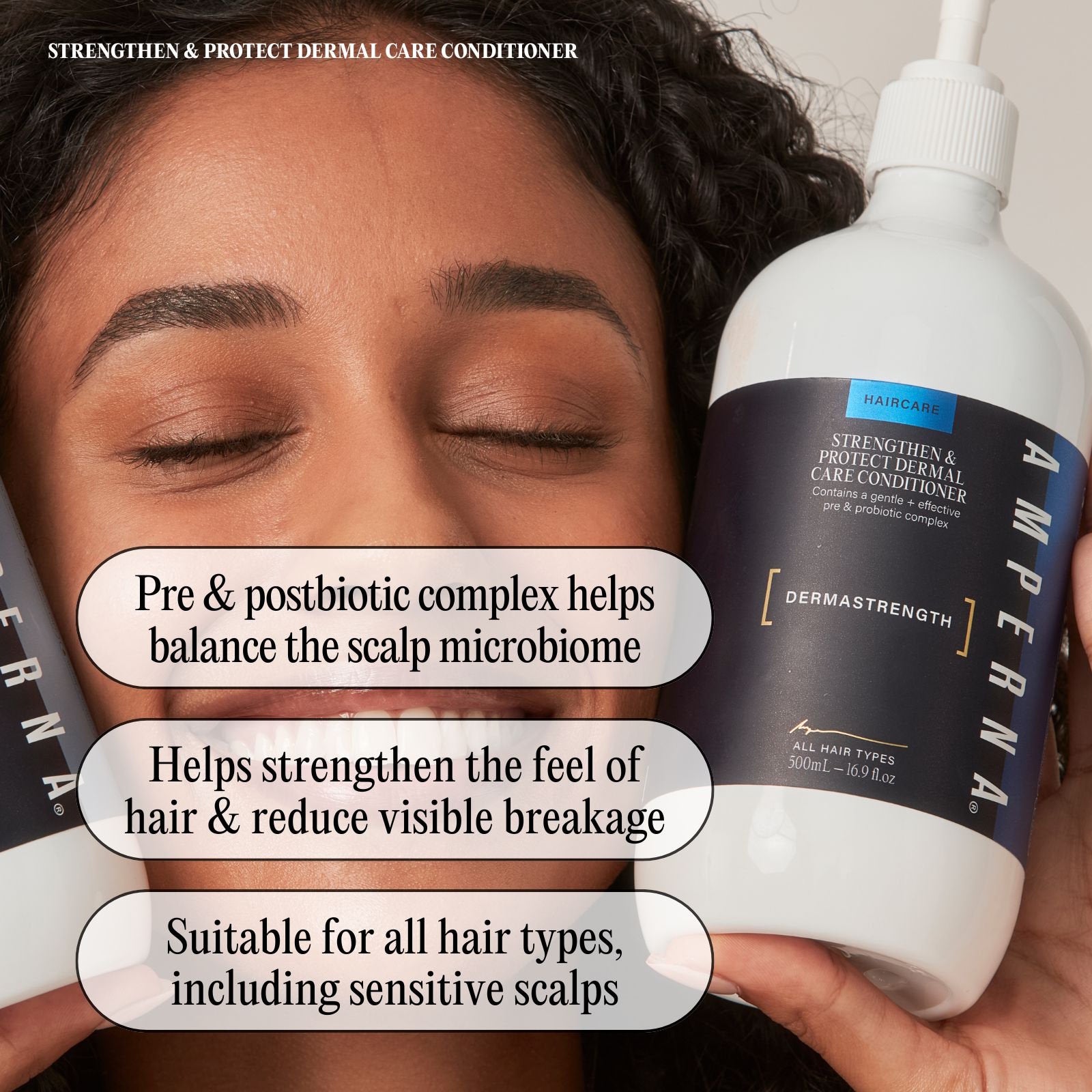
Shampoo and conditioner can run over the face, neck and body in the shower. Hair can sit against your face throughout the day. Body products may come into contact with the jawline and neck.
That's one reason AMPERNA® has taken our barrier-focused approach beyond facial skincare.
FACE. BODY. SCALP.
Explore AMPERNA® Skincare
Explore AMPERNA® Bodycare
Explore AMPERNA® Haircare

My Personal Experience With Perioral Dermatitis
I understand how frustrating it can feel when your skin suddenly changes.
I experienced perioral dermatitis during the early years of building AMPERNA®.
Like many people, I searched for answers and tried different approaches, hoping to find something that would quickly fix my skin.
What I eventually learned was that my skin did not need more.
It needed simplicity.
I focused on:
- Reducing irritation
- Supporting my skin barrier
- Being consistent
- Understanding my skin microbiome
This experience became one of the reasons AMPERNA® exists today.
I wanted to create skincare that supported sensitive, reactive skin and worked with the skin’s natural ecosystem.
My Gentle Routine For Sensitive Skin Around The Mouth
When your skin feels reactive, a simple routine can help provide the support your skin needs.
Step 1: Cleanse
Cleanse with cool water only
Step 2: Support
Pro+ DS Soothing Serum [RESCUE]
A lightweight serum formulated with AMPERNA®’s postbiotic complex to support the skin microbiome and help maintain balanced-looking skin.
Step 3: Moisturise
Lightweight Soothing+ Emulsion [HYDRATE]
A lightweight moisturiser designed to support hydration and skin barrier function.
Step 4: Refresh
Pro+ SOS Daily Facial Spray [SUPACALM]
A refreshing mist designed to support skin comfort throughout the day. This postbiotic spray can be used after cleansing with water too.
Step 5: Protect
Pro+ Bio Soothing Day Mineral CC SPF15
Daily sun protection helps support your skin against environmental stressors.
Frequently Asked Questions
Is angular cheilitis the same as perioral dermatitis?
No. Angular cheilitis generally affects the corners of the mouth, while perioral dermatitis typically occurs around the mouth and can also appear around the nose and eyes.
Does angular cheilitis only occur in the corners of the mouth?
Angular cheilitis characteristically affects one or both corners of the mouth. If you're experiencing irritation elsewhere around your mouth, seek professional advice rather than assuming it is angular cheilitis.
Can perioral dermatitis affect the corners of the mouth?
Perioral dermatitis occurs around the mouth, but its distribution is different from the characteristic cracks and fissures seen directly at the corners with angular cheilitis.
Why do the corners of my mouth keep cracking?
There are several possible reasons, including repeated saliva exposure, dry skin, fungal or bacterial involvement and other contributing factors. Recurrent or persistent cracking should be assessed by a healthcare professional.
Should I use skincare on angular cheilitis?
Angular cheilitis can have causes that require medical treatment, so skincare shouldn't be positioned as a treatment for it. Seek advice from a doctor or dermatologist if you think you may have angular cheilitis.
The Bottom Line
Angular cheilitis and perioral dermatitis aren't the same thing.
Angular cheilitis typically affects the corners of the mouth, while perioral dermatitis usually appears on the skin surrounding the mouth and can extend around the nose and eyes.
Understanding that distinction can help you take the appropriate next step.
And when it comes to the rest of your skincare routine, our philosophy remains simple:
Support your skin. Don't overwhelm it.
AMPERNA® products are cosmetic only and are not intended to treat, cure or prevent angular cheilitis, perioral dermatitis or any other disease or skin condition. If you are concerned about your skin, seek advice from a qualified healthcare professional.
Final Thoughts
Angular cheilitis and perioral dermatitis can look similar, but understanding the difference is the first step towards supporting your skin.
Throughout my own skin journey, I have learned that sensitive skin does not usually respond well to aggressive routines.
Instead, consistency, barrier support and gentle skincare have become the philosophy behind everything we create at AMPERNA®.
If your skin is feeling irritated around your mouth, remember:
Healthy-looking skin starts with supporting your skin - not fighting against it.
Sources:
https://www.aad.org/public/diseases/a-z/perioral-dermatitis
http://www.pcds.org.uk/clinical-guidance/angular-chelitis
https://dermnetnz.org/topics/exfoliative-cheilitis/