Finding more hair than usual in your shower, hairbrush or on your pillow can be unsettling.
Maybe your ponytail suddenly feels thinner.
Perhaps you're noticing more hair coming out when you shampoo.
Or your hair simply doesn't feel as full as it once did.
Naturally, the first question is often:
Why is my hair falling out?
Hair can change for many reasons. Stress, hormonal changes, illness, genetics, nutrition, age, styling habits, chemical processing and even the way we care for our hair can all play a role.
It's also important to understand that hair shedding, hair thinning and hair breakage aren't necessarily the same thing.
And while you're trying to understand what's happening with your hair, there's another area worth paying attention to:
Your scalp.
At AMPERNA®, we believe healthy-looking hair starts with caring for the skin underneath it.
That's why we've taken our barrier-first, microbiome-conscious approach to skincare and extended it into scalp + hair care.
Let's start with what's actually happening when you notice more hair falling out.
Is It Normal for Hair to Fall Out Every Day?
Yes.
Hair naturally moves through different stages of growth and shedding, so seeing some hair in your brush or shower is completely normal.
The American Academy of Dermatology notes that it's normal to shed approximately 50 to 100 hairs each day. When significantly more hairs are being shed, this is known as excessive hair shedding.
Of course, nobody is expected to count individual hairs.
You may simply notice:
More hair in the shower drain
More hair coming out when shampooing
More hair in your brush
Hair accumulating on your clothing or pillow
A ponytail that feels thinner
Your part appearing wider
Less overall volume
If something has noticeably changed, it's worth considering what might have happened in the preceding weeks or months.
Hair Shedding vs Hair Loss: What's the Difference?
These terms are often used interchangeably, but they're not necessarily describing the same thing.
Hair shedding is part of the natural hair cycle.
Sometimes considerably more hairs move into the shedding phase than usual. One form of excessive shedding is called telogen effluvium.
The AAD notes that telogen effluvium can occur following significant stressors including childbirth, high fever, illness, surgery and major emotional stress. Interestingly, the increased shedding may not become noticeable until a few months after the triggering event.
Hair loss can have other underlying causes, including hereditary factors.
Then there's hair breakage.
Breakage happens when the hair shaft itself snaps rather than the entire strand shedding from the root.
So if your hair suddenly seems thinner, the first question isn't necessarily "What hair growth product should I buy?"
It's:
What's actually happening to my hair?

1. Stress Can Affect Hair Shedding
Stress doesn't only affect how we feel.
Significant physical or emotional stress can influence the natural hair cycle too.
A stressful event can cause more hairs to move into the resting phase of the growth cycle, with increased shedding becoming noticeable later.
That's why you may start noticing more hair in your shower months after a particularly stressful period rather than while you're actually experiencing it.
This delay can make the connection difficult to recognise.
Your life may have returned to normal, but your hair can still be reflecting something your body experienced earlier.
If your hair has changed alongside your lifestyle or general wellbeing, our guide to taking a holistic approach to haircare looks more broadly at the everyday factors that can influence how your hair and scalp look and feel.
2. Hormonal Changes Can Influence Your Hair
Hormones can influence the hair growth cycle throughout different stages of life.
Pregnancy and the months following childbirth are a well-known example.
Many people notice thicker-feeling hair during pregnancy followed by significantly more shedding after giving birth.
The AAD identifies childbirth as one of the common triggers for excessive shedding, with the change often becoming noticeable a few months later.
Hormonal changes can occur at other stages of life too.
If you've noticed changes after pregnancy, our article on postpartum skin and hair changes looks specifically at increased shedding, thinner-feeling hair and how a gentle scalp + hair routine can support your hair during this period.
3. Illness or Physical Stress Can Trigger Shedding
Sometimes your hair reflects what your body has been through.
A significant illness, high fever or surgery can be followed by increased hair shedding.
Again, this doesn't necessarily happen immediately.
The AAD notes that excessive shedding may become noticeable several months after the triggering event.
That can make sudden shedding particularly confusing.
By the time your hair starts changing, you may feel completely recovered.
4. Genetics and Age Can Play a Role
Hair naturally changes throughout our lives.
For some people, genetics also play an important role in hair density and thinning.
You may begin noticing:
A wider-looking part
Less density around the hairline
Reduced volume
Finer-feeling hair
Gradual thinning
Unlike a sudden period of increased shedding, genetically influenced thinning may occur progressively.
If you've noticed a significant or unexplained change in your hair density, speaking with a doctor or dermatologist can help you understand what's happening.
5. Nutrition Can Influence Hair Health
Hair doesn't exist independently from the rest of your body.
Your overall nutrition matters too.
Significant dietary changes, restrictive eating patterns or nutritional deficiencies can sometimes coincide with changes to the hair.
Rather than guessing which vitamin or supplement you need based on your hair alone, speak with your healthcare professional if you're concerned about persistent or unexplained shedding.
Supporting healthy-looking hair is about more than what you put on it.
6. Your Hairstyle Could Be Putting Stress on Your Hair
Slick buns.
Tight ponytails.
Braids.
Extensions.
Clips.
Hair ties.
We all have our favourite hairstyles, but repeatedly creating significant tension on the same areas of hair can place unnecessary stress on the strands and roots.
Try alternating your hairstyles and giving your hair a break from constant pulling.
This is particularly worth considering if you're noticing changes around your temples or hairline.
And tight hairstyles aren't the only everyday habit worth reconsidering.
Our guide to 10 everyday hair habits that could be affecting your scalp health looks at dry shampoo, styling products, heat, hair colour, washing habits and other things your scalp encounters during an average week.

7. Heat, Bleaching and Chemical Processing Can Contribute to Breakage
Sometimes hair that appears to be "falling out" is actually breaking.
Bleaching.
Hair colouring.
Chemical processing.
Straightening.
Curling.
Repeated heat styling.
These can all affect the condition of the hair shaft.
When hair becomes increasingly fragile, strands may snap through the lengths, making the hair appear thinner or less full.
Look closely at what you're finding.
Are you seeing full-length strands?
Or are there shorter broken pieces?
Do the ends feel increasingly dry?
Does your hair feel fragile when wet?
Are you noticing breakage around areas you regularly heat style?
Hair shedding and hair breakage can look surprisingly similar when all you're seeing is hair in your bathroom.
This is why caring for the existing hair matters too.
8. Dry Shampoo and Product Buildup Can Change How Your Scalp Feels
Dry shampoo can be incredibly convenient.
But dry shampoo doesn't actually wash your scalp.
It helps absorb excess oil.
When it's repeatedly layered alongside natural oils, sweat, styling creams, hairspray, waxes and other products, buildup can accumulate between washes.
That doesn't mean you need to aggressively scrub your scalp.
It means regular, effective cleansing matters.
If you use a lot of styling products, focus your shampoo where the cleansing is actually needed:
Your scalp and roots.
Massage gently with your fingertips and rinse thoroughly.
Our article on 10 everyday hair habits that could be affecting your scalp health goes deeper into dry shampoo and product buildup, along with simple ways to rethink your wash-day routine.
9. Your Scalp Deserves Attention Too
Most haircare marketing focuses on the strands.
Shine.
Volume.
Strength.
Smoothness.
Colour.
But underneath all of that hair is skin.
Your scalp has its own skin barrier and microbiome and is regularly exposed to sweat, oil, environmental impurities, styling products, hair colour and heat.
At AMPERNA®, this is why we've approached haircare a little differently.
We think about:
The scalp
The scalp barrier
The scalp microbiome
Hydration
Gentle cleansing
Hair strength and condition
Rather than thinking about shampoo purely as something that cleans hair, we think about the skin underneath it too.
If you're new to this approach, our introduction to AMPERNA® DERMACARE Haircare explains why we took the principles behind our skincare and applied them to scalp + hair care.
10. Scalp Changes Can Happen Alongside Hair Changes
If your hair is changing, take a look at your scalp too.
Does it feel:
Dry?
Tight?
Flaky?
Oily?
Uncomfortable?
Different from usual?
Flaking, for example, is often automatically labelled as dandruff when dryness may also be involved.
Our guide to dry scalp vs dandruff explains some of the differences and what to consider when your scalp suddenly starts feeling flaky or uncomfortable.
Persistent or significant changes to your scalp or hair are worth discussing with an appropriate healthcare professional.
Why Scalp Health Matters When Your Hair Is Thinning or Shedding
If you're noticing more shedding than usual, it's easy to focus exclusively on the hair you're losing.
We'd also think about how you're caring for the hair and scalp you have.
Your scalp is the environment surrounding your hair follicles.
It has a skin barrier.
It has a microbiome.
It produces oil.
It accumulates sweat and product buildup.
And it deserves the same kind of considered care we routinely give to the skin on our face.
That's the thinking behind AMPERNA® DERMACARE.
Skincare for your scalp.
Our range has been developed around gentle cleansing, hydration, conditioning, microbiome-conscious ingredients and supporting healthy-looking hair.
Meet [DERMACLEANSE]: A Scalp-First Shampoo
The first step is cleansing.
AMPERNA® Cleanse & Rebalance Dermal Care Shampoo [DERMACLEANSE] is a fragrance-free, sulfate-free shampoo developed with both your scalp and hair in mind.
It gently removes excess oil, everyday impurities and product buildup without the goal of leaving your scalp feeling aggressively stripped.
The formula includes AMPERNA®'s prebiotic and postbiotic complex, alongside hydrating ingredients including Glycerin and Hyaluronic Acid derivatives.
Think of it as bringing our skincare approach into the shower.
CLEANSE YOUR SCALP. CARE FOR YOUR HAIR.
If your scalp is sensitive or easily unsettled, our article on ingredients to consider when choosing products for sensitive skin or scalp explains why fragrance, cleansing agents and the overall formulation are worth thinking about.
DISCOVER [DERMACLEANSE] SHAMPOO →

Support the Hair You Already Have With [DERMASTRENGTH]
If your hair is shedding or feeling thinner, it's particularly important to distinguish shedding from breakage.
That's where conditioning your existing hair becomes important.
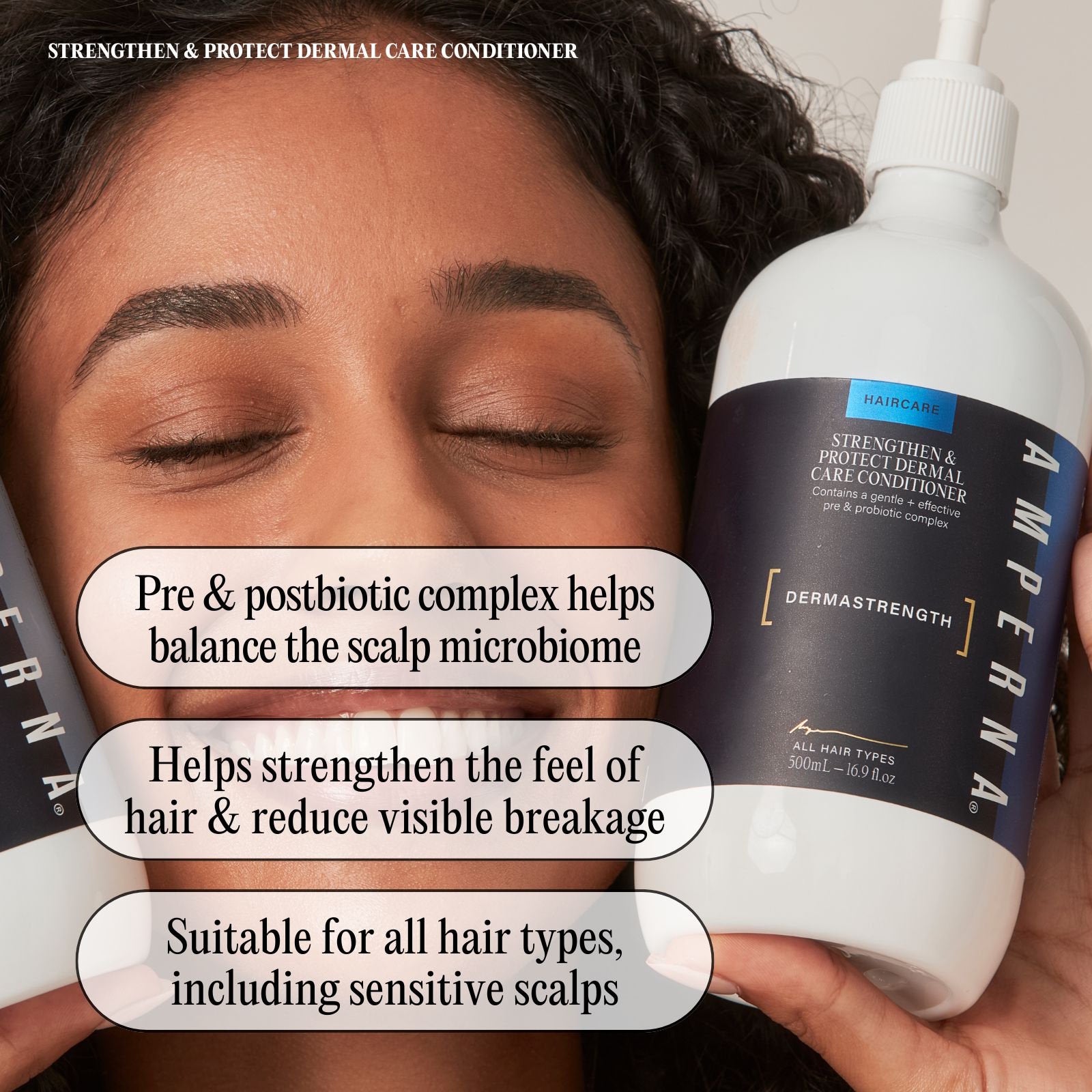
AMPERNA® Strengthen & Protect Dermal Care Conditioner [DERMASTRENGTH] was designed to complement DERMACLEANSE and support softness, strength and manageability.
The formula contains a blend of amino acids and conditioning ingredients to help support stronger, healthier-looking hair.
Because when you're worried about losing hair, taking good care of the strands you already have matters too.
Together:
DERMACLEANSE → DERMASTRENGTH
CLEANSE → CONDITION
DISCOVER THE AMPERNA® HAIRCARE DUO →
Give Your Scalp Its Own Serum
We use serums on our face.
So why have we traditionally stopped our scalp routine at shampoo?
AMPERNA® Scalp & Hair Care Serum [DERMAFIX] takes our skincare philosophy directly to the scalp.
DERMAFIX is a targeted, skincare-inspired scalp serum formulated to support scalp hydration, comfort, the scalp barrier and microbiome.
It includes ingredients such as:
Niacinamide
Glycerin
Alpha-Glucan Oligosaccharide
Calcium Pantothenate
Lactobacillus-derived postbiotic technology
Think of it as:
A SERUM FOR YOUR SCALP.
It's designed to complement DERMACLEANSE and DERMASTRENGTH and make dedicated scalp care part of your regular routine.
Our introduction to DERMAFIX Scalp & Hair Care Serum explains why we created it and the different ways you can incorporate it into your wash-day routine.
DISCOVER [DERMAFIX] SCALP & HAIR CARE SERUM →
What Does the Scalp Microbiome Have to Do With It?
Your scalp is home to a community of microorganisms collectively known as the scalp microbiome.
This is one of the reasons AMPERNA®'s move from facial skincare into haircare made so much sense to us.
We've spent years thinking about the skin barrier and microbiome.
Why should that thinking stop at your hairline?
AMPERNA® DERMACARE incorporates prebiotic and postbiotic ingredients as part of our microbiome-conscious approach to scalp care.
If you'd like to understand this side of your haircare routine in more detail, our article on prebiotics and postbiotics in skincare explains what these terms actually mean and why AMPERNA® has built so much of its formulation philosophy around the microbiome.
What Should Your Haircare Routine Look Like When Your Hair Is Shedding?
When you notice more hair falling out, it's tempting to completely overhaul your routine.
New shampoo.
New supplements.
Scalp scrub.
Hair mask.
Oil.
Serum.
Another treatment.
Then another one.
We prefer a simpler approach.
Start with your scalp.
Keep cleansing gentle.
Remove product buildup regularly.
Avoid unnecessarily aggressive scalp scrubs.
Be mindful of excessive heat.
Reduce constant tension from very tight hairstyles.
Condition your hair properly.
And introduce targeted scalp care consistently.
That's the philosophy behind our complete AMPERNA® scalp + hair routine.

The AMPERNA® Scalp + Hair Routine
[DERMAFIX]
SUPPORT
Targeted skincare-inspired support for your scalp.
Apply as part of your scalp-care ritual before washing.
↓
[DERMACLEANSE]
CLEANSE
Gently cleanse your scalp, roots and hair while removing excess oil and everyday buildup.
↓
[DERMASTRENGTH]
CONDITION
Support softer, stronger and healthier-looking hair.
Three purposeful steps.
SCALP → CLEANSE → CONDITION
If you want to go deeper into building a healthier scalp routine, our guide to 10 everyday hair habits that could be affecting your scalp health is a great place to continue.
EXPLORE AMPERNA® SCALP + HAIR CARE →
When Should You Speak to a Doctor About Hair Loss?
Hair shedding and thinning can happen for many different reasons.
If the change is sudden, significant, persistent or unexplained, speak with your doctor or dermatologist.
It's also worth seeking professional advice if you're noticing bald patches, significant scalp changes or other symptoms occurring alongside the hair loss.
Understanding the cause gives you a much better starting point for deciding what to do next.
Your Haircare Routine Starts With Your Scalp
When your hair starts shedding or feeling thinner, it's natural to concentrate on what you're losing.
But don't forget about what you're caring for.
Your scalp.
Your existing hair.
Your everyday routine.
Stress, hormones, illness, genetics, age, nutrition and styling habits can all influence the story of our hair.
At AMPERNA®, our role is to make the scalp + hair care part simpler.
A gentle shampoo.
A strengthening conditioner.
A targeted scalp serum.
All developed around the same philosophy that sits behind our skincare:
Your scalp is skin. Treat it like skin.
EXPLORE AMPERNA® DERMACARE SCALP + HAIR CARE →
Frequently Asked Questions
Why is my hair suddenly falling out?
Increased hair shedding can occur for a variety of reasons, including significant stress, illness, hormonal changes and other major changes affecting the body. One form of excessive shedding, telogen effluvium, may become noticeable several months after the triggering event.
How much hair shedding is normal?
The American Academy of Dermatology says it's normal to shed approximately 50 to 100 hairs each day.
Can stress make your hair fall out?
Significant physical or emotional stress can trigger excessive hair shedding known as telogen effluvium. The increased shedding can appear months after the stressful event.
Why is my hair falling out in the shower?
Shampooing can make naturally shed hairs more noticeable because loose strands are released as you wash and handle your hair. If you've noticed a significant increase in shedding or changes to your overall hair density, consider speaking with a healthcare professional.
Why does my hair feel thinner?
Hair can appear or feel thinner for several reasons, including increased shedding, changes in hair density and hair breakage. Looking at whether you're losing full-length strands or seeing shorter broken hairs can help you start distinguishing between shedding and breakage.
Can hair breakage make my hair look thinner?
Yes. When weakened hair shafts break along their lengths, the overall hair can begin to appear less full. Conditioning, reducing unnecessary heat and chemical stress and handling fragile hair gently can help maintain the condition of existing strands.
Does scalp health matter for healthy-looking hair?
Your scalp is the skin environment surrounding your hair follicles and has its own barrier and microbiome. Keeping it clean, hydrated and well cared for is an important part of a considered haircare routine.
What is a scalp serum?
A scalp serum is a leave-on or pre-wash product formulated specifically for the skin of the scalp. AMPERNA® [DERMAFIX] is a skincare-inspired scalp serum designed around hydration, barrier support, microbiome-conscious care and scalp comfort.