For years, conversations around menopause focused on hot flushes, sleep, mood and changes to your cycle. We didn’t talk nearly enough about skin. But your skin can change significantly during and after menopause, and for many women those changes can feel quite noticeable.
Your skin may become drier, thinner or more sensitive. You may notice changes in firmness, elasticity and texture, while pigmentation that has accumulated over decades of sun exposure can become more visible. And, rather unfairly, some women can still experience breakouts at the same time. It can feel like several different skin concerns are suddenly appearing all at once.
If you’ve arrived here after reading my guide to perimenopause and skin, menopause is the next part of that conversation. Perimenopause can feel particularly unpredictable because hormones are fluctuating, whereas menopause brings a more sustained decline in estrogen.
As estrogen levels decline, there are more established changes that can occur within the skin, including changes to collagen, elasticity and its ability to retain moisture. So while I don’t believe you suddenly need an entirely new bathroom cabinet because you’ve reached menopause, I do think it’s worth reconsidering what your skin needs now.
As someone who has spent years developing skincare for sensitive and easily unsettled skin, my philosophy remains very simple: support the skin first. Then target the things you want to change.
What Happens to Your Skin During Menopause?
Menopause is officially reached when you have gone 12 consecutive months without a menstrual period. One of the major biological changes associated with menopause is declining estrogen, a hormone involved in many aspects of skin physiology, including collagen production, hydration, thickness and elasticity.
As estrogen declines, research has associated menopause with reduced collagen and elasticity, increased dryness, a reduced ability to retain moisture, thinner skin, changes in texture and more visible lines and wrinkles. A recent review of menopausal skin research also describes declining estrogen as contributing to reduced collagen production, elasticity and moisture retention.
So if you look in the mirror and think your skin seems to have changed quite dramatically over a relatively short period of time, you’re not necessarily imagining it. There are genuine biological changes happening during this stage of life that can influence how your skin looks and feels.
But this is also where I think we need to be careful. Not every change you see in your skin during menopause is necessarily caused by menopause. We’re also getting older, we’ve accumulated decades of sun exposure, our lifestyles and health can change, and the products and routines we use can change too.
Rather than trying to blame every line, spot or breakout on hormones, I prefer to look at what my skin is actually telling me. What feels different? What does it need more of? What might it need less of? From there, I think it makes much more sense to build a considered routine around the skin you have now, rather than trying to follow a generic idea of what “menopause skincare” should look like.

Menopause Skincare Doesn’t Need to Be Aggressive
One of the things I dislike about the way skincare is marketed to women as we get older is the language. Fight ageing. Reverse ageing. Correct everything. Erase wrinkles. Turn back time. I don’t think we need to be at war with our faces, and I don’t think getting older means we suddenly need to attack our skin with every active ingredient available.
There are absolutely things I want from my skincare as I get older. I want my skin to look bright and feel hydrated. I care about texture, uneven-looking tone and fine lines. But I also want my skin to feel comfortable. I’m not interested in compromising that just so I can say I’m using every trending active ingredient at once.
I’m Not Trying to Make My Skin Look 25
I want my skin to look like healthy, well-cared-for skin at the age I am now. That’s a very different objective. I can care about how my skin is ageing without feeling as though every line or change in texture is something that needs to be erased.
It’s one of the reasons my philosophy around AMPERNA® has become increasingly simple: barrier first. Targeted ingredients second. Consistency always. Give your skin a strong foundation, decide what you actually want to target and then introduce those ingredients thoughtfully.
1. Start With Gentle Cleansing
If your skin has become drier during or after menopause, your cleanser deserves another look. Your face doesn’t need to feel tight after cleansing to be clean. In fact, if you immediately want to run for your moisturiser after washing your face, I’d question whether the cleanser you’ve always used is still right for your skin now.
Our Ultra Gentle Soothing Cleanser [BALANCE] was developed as a gentle everyday cleansing step. It removes makeup and everyday impurities without the goal of leaving your skin feeling squeaky clean or stripped.
That’s exactly what I want from a cleanser. Let your cleanser cleanse. It doesn’t need to exfoliate, resurface, brighten and do five other things at the same time. There are other steps in your routine for that.
2. Make Hydration a Priority
If menopause has left your skin feeling drier, hydration may need to play a bigger role in your routine than it did previously. You may find yourself reaching for moisturiser more regularly, or simply noticing that your skin feels more comfortable when you’re consistent with hydration.
Our Lightweight Soothing+ Emulsion [HYDRATE] contains ceramides, cholesterol and hyaluronic acid in a lightweight moisturising formula. I particularly like the idea of lightweight but consistent hydration, because more hydration doesn’t necessarily have to mean a much heavier skincare routine.
You don’t automatically need to jump from a lightweight moisturiser to the thickest cream you can find just because you’ve reached menopause. Pay attention to your skin. If it needs more, give it more. If it feels comfortable, you don’t need to overload it.
3. Keep Supporting Your Skin Barrier
Menopause doesn’t suddenly make the fundamentals of skincare irrelevant. Your skin still has a barrier. It still has a microbiome. It still needs hydration, and it still benefits from a routine that isn’t constantly changing.
That’s why the AMPERNA® approach doesn’t suddenly change because you’re 50, 55 or 60. Our Pro+ DS Soothing Serum [RESCUE] contains our postbiotic complex alongside ingredients including niacinamide, panthenol, copper and zinc gluconates.
For me, RESCUE + HYDRATE remain the supportive heart of an AMPERNA® routine. Together, they’re also our Soothing Duo. If your skin has become dry, easily unsettled or you simply don’t know where to begin, I wouldn’t start by introducing six different active ingredients. I’d start with a simple foundation and see what your skin actually needs from there.
RESCUE → HYDRATE
4. Then Think About What You Actually Want to Target
Once your skin feels comfortable, this is where things get more interesting. Barrier-first skincare doesn’t mean you can’t use actives. I love active skincare. It simply means introducing targeted ingredients into a routine that already has a solid foundation rather than asking your skin to cope with everything at once.
Before adding another product, I think it’s worth asking yourself what you actually want from your skincare. Is brightness your priority? Uneven-looking tone? Smoother-looking texture? Antioxidant support? Are you interested in introducing a retinoid? You might have several concerns, but that doesn’t necessarily mean you need a separate product for every single one of them.
If You Want Vitamin C: Add [REPAIR]
If brightness and antioxidant support are priorities for you, Vitamin C can be a useful addition to your routine. Our Pro+ Vitamin C Hyaluronic Serum [REPAIR] combines Vitamin C with hyaluronic acid and is an easy way to BUILD on the supportive foundation you already have.
For example, my morning routine might look like BALANCE → REPAIR → RESCUE → HYDRATE → SPF. Each product has a clear place and purpose within the routine, without making things unnecessarily complicated.
MORNING
BALANCE → REPAIR → RESCUE → HYDRATE → SPF
That’s already a comprehensive skincare routine. You don’t necessarily need another four serums on top of it.

If Uneven-Looking Tone Is Your Focus: Add [SUPAGLOW]
Decades of sun exposure can become increasingly visible as we get older, and things like sun spots, uneven-looking tone and areas of pigmentation may become more noticeable around menopause. If brightness and a more even-looking complexion are becoming priorities for you, this is where I’d start thinking about targeted brightening ingredients.
Our Pro+ Advanced Brightening Serum [SUPAGLOW] brings together Alpha Arbutin, Niacinamide, 3-O-Ethyl Ascorbic Acid, Oxyresveratrol and Lactic Acid in one formula. I like this approach because you don’t necessarily need separate bottles of niacinamide, Vitamin C, Alpha Arbutin and exfoliating ingredients sitting in your bathroom.
We’ve already done the ingredient stacking for you. It means I can introduce a targeted brightening step without turning my routine into five additional steps, which fits perfectly with how I think skincare should work as my skin changes.
If Texture and Fine Lines Are Your Focus: Consider a Retinoid
Collagen loss is one of the better documented skin changes associated with menopause. The American Academy of Dermatology notes that collagen loss accelerates around menopause and recommends sun protection as a fundamental step, with retinoids among the options people may consider when visible signs of ageing are a concern.
AMPERNA® offers two different approaches. Our Pro+ Bio Resurfacing Retinol ALT [SUPERADIANCE] contains bakuchiol for those looking for a retinol-alternative approach, while our Pro+ Bio Resurfacing Retinol RX [SUPERFOLIATE] contains Hydroxypinacolone Retinoate (HPR) for those looking for a more advanced retinoid step.
But I wouldn’t introduce a retinoid, an exfoliating acid and three other new serums on the same night. BUILD gradually. Introduce one thing at a time, use it consistently and give your skin enough time to tell you what it thinks before deciding you need something else.
Can You Still Get Acne During Menopause?
Yes. Which seems particularly unfair when you’re simultaneously thinking about fine lines and wrinkles. Hormonal changes before and during menopause can contribute to adult breakouts, while the skin itself may also be becoming drier and more easily irritated.
This is why I wouldn’t necessarily approach breakouts at 50 in exactly the same way I would have approached teenage acne. If you’re experiencing breakouts and dryness at the same time, I’d think about gentle cleansing, lightweight hydration and barrier support first, followed by targeted skincare when your skin is comfortable.
Our Clear & Calm Collection is one option when you’re ready to BUILD a more comprehensive routine around clearer, smoother-looking skin. But if adult acne is persistent, painful, severe or has changed suddenly, it’s worth discussing it with your doctor or dermatologist, particularly if skincare alone isn’t controlling it.
What About Redness and Sensitive Skin During Menopause?
Skin can become more easily irritated around menopause, and dermatologists note that existing conditions such as rosacea or eczema may also become more troublesome for some people. If you’re already someone whose skin is easily unsettled, you may become more conscious of what you’re putting on it during this stage.
This is another area where I don’t think more products are automatically the answer. If your skin suddenly seems unhappy with everything you’re putting on it, simplify. Look at how frequently you’re exfoliating, how many active ingredients you’re layering, whether fragrance could be contributing to irritation and whether your cleanser is leaving your skin feeling stripped.
Sometimes giving your skin some space is more useful than immediately introducing another product. If redness, itching, rashes or other significant skin changes persist, speak to your doctor or dermatologist rather than assuming menopause is responsible.
Don’t Forget About Your Neck, Chest and Body
We spend an enormous amount of time talking about menopausal facial skincare while the rest of our skin is quietly changing too. Your neck, chest, arms, hands and legs can all become drier, and I think body skincare deserves a much bigger place in this conversation.
This is one of the reasons we’ve expanded AMPERNA® beyond facial skincare. Our Hydrating Gentle Wash with Ceramides [CERALACTIC] and Hydrating Gentle Body Lotion with Ceramides [HYDRALACTIC] bring the same barrier-first philosophy into the shower and onto the rest of the body.
We’re increasingly thinking about the skin as a whole rather than treating facial skincare as something completely separate from everything else. Your skincare shouldn’t stop at your jawline.
And Your Scalp Is Skin Too
This is something I think is still overlooked in conversations about menopause. Hair changes are common around this stage of life too. The AAD notes that women may notice thinning scalp hair, including changes such as a widening part or receding hairline, and recommends medical assessment because there are many potential causes of hair loss.
Regardless of whether you’re experiencing changes to your hair, your scalp is still skin. It has a barrier. It has a microbiome. And it deserves thoughtful care. I think we’ve spent years focusing on what our hair looks like while giving very little thought to the skin underneath it.
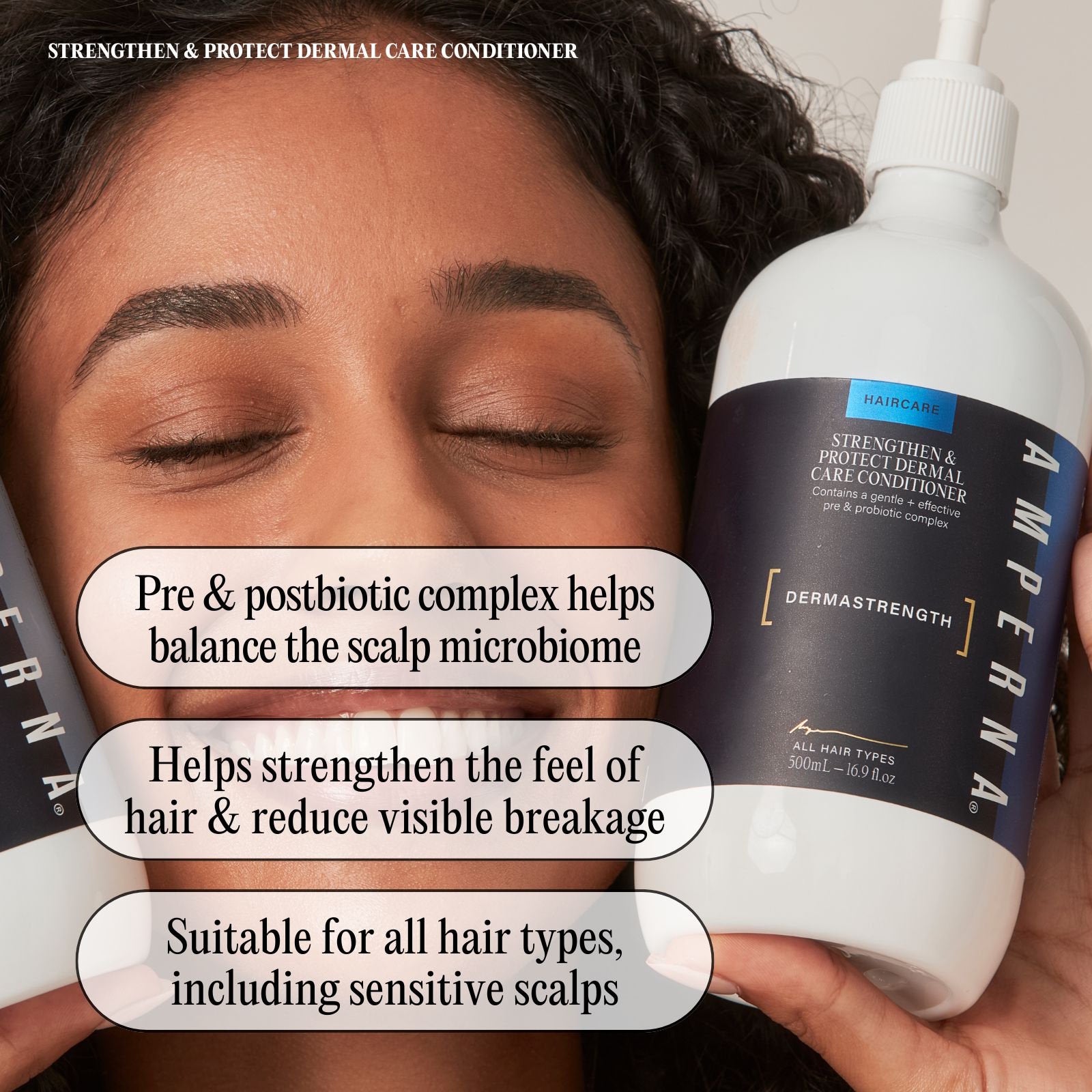
That’s why AMPERNA® now extends across SKIN. BODY. HAIR. Our approach to scalp care follows the same thinking that shaped our facial skincare: support the scalp, cleanse thoughtfully, avoid unnecessarily stripping it and think about the environment you’re creating for healthy-looking hair.
You can explore our AMPERNA® scalp + hair care range.
SPF Becomes Even More Important
If there’s one step I don’t want women skipping as they get older, it’s sunscreen. A significant proportion of the pigmentation, wrinkles and uneven-looking tone we associate with ageing is influenced by cumulative sun exposure, so protecting your skin every day is one of the most important long-term habits you can build.
Dermatologists recommend broad-spectrum SPF 30 or higher every day, including during and after menopause. And if you’re introducing Vitamin C, exfoliating acids, brightening ingredients or retinoids into your routine, sun protection should be a fundamental part of your approach.
Don’t spend all that time thinking about your skincare and forget the step that helps protect your skin from further sun exposure.
A Simple AMPERNA® Menopause Skincare Routine
If I were helping someone who said, “I’ve reached menopause and I have no idea what skincare I should be using anymore,” I wouldn’t hand them ten products. I’d start by creating a simple foundation that covers cleansing, support, hydration and daily sun protection.
MORNING
BALANCE
Ultra Gentle Soothing Cleanser
↓
REPAIR
Pro+ Vitamin C Hyaluronic Serum
↓
RESCUE
Pro+ DS Soothing Serum
↓
HYDRATE
Lightweight Soothing+ Emulsion
↓
SPF
EVENING
BALANCE
↓
RESCUE
↓
HYDRATE
That’s your foundation. From there, you can BUILD according to your skin and what you actually want to target. You don’t need to introduce everything at once, and you certainly don’t need to use every active product every night.
For brightness and uneven-looking tone, you might introduce SUPAGLOW. For texture and renewal, you might consider SUPERADIANCE or SUPERFOLIATE. If exfoliation is something your skin would benefit from, EXFOLIATE can be introduced gradually rather than becoming an automatic everyday step.
Getting older doesn’t mean your skincare routine needs to become progressively more complicated. Sometimes knowing what not to use is just as important as knowing what to add.
Do You Need Special “Menopause Skincare”?
This is where my opinion is probably a little different from some of the marketing you’re seeing. I don’t think your skincare needs the word MENOPAUSE printed across the bottle to work for menopausal skin. I think it needs to be appropriate for what your skin actually needs.
If your skin is dry, support hydration. If it has become more sensitive, simplify. If pigmentation and brightness are becoming priorities, choose ingredients designed around those cosmetic goals. If you want to introduce a retinoid, do it gradually and pay attention to how your skin responds.
And if your skin feels perfectly comfortable with a simple three-product routine, you don’t need to turn it into ten steps because you’ve had a birthday. Your skin doesn’t read the label. It responds to the products and ingredients you actually put on it.
What About Postbiotics During Menopause?
Postbiotics remain at the heart of AMPERNA® because our philosophy isn’t based around a particular age group. It’s based around skin. We think about the skin barrier, microbiome, hydration and consistency first, and then layer in more targeted ingredients according to what someone actually wants from their skincare.
That’s why I don’t think of AMPERNA® as “young skin” or “mature skin” skincare. I think of it as a system that can adapt as your skin changes. Your routine at 35 doesn’t necessarily need to look exactly the same at 45, 55 or 65, but that doesn’t mean you have to start again every time your skin changes.
Menopause is a perfect example of why that adaptability matters. Start with your foundation, pay attention to your skin and BUILD according to what it needs now.
You can learn more about probiotics, prebiotics and postbiotics in skincare

Your Skin Is Changing. Your Skincare Can Change With It.
I think there’s something incredibly liberating about accepting that your skin at 50 doesn’t need to look like your skin at 25. That doesn’t mean giving up on your skin or caring less about how it looks and feels. Quite the opposite. It means understanding it better, supporting it and choosing products because they make sense for your skin now, rather than because you’re trying to erase every sign that you’ve lived.
Menopause can change your skin, so I think it makes sense to let your skincare evolve with it. Go back to the foundation and make sure those everyday essentials are working for you. Cleanse gently. Support your barrier. Hydrate. Wear SPF. These are the things I come back to again and again, regardless of what stage my skin is going through.
Then you can BUILD according to what you actually want from your routine. Maybe brightness and more even-looking tone are becoming priorities. Perhaps you’re thinking more about texture, exfoliation or introducing a retinoid. Whatever matters to you, there are targeted ingredients you can explore when your skin is ready for them. But you don’t need to introduce everything at once, and you certainly don’t need to feel pressured into having a complicated routine simply because you’re getting older.
For me, good skincare at this stage of life isn’t about trying to turn back the clock. It’s about looking after the skin I have today and helping it look and feel its best. Healthy-looking skin doesn’t have an age limit.
EXPLORE AMPERNA® SKINCARE, BODYCARE AND HAIRCARE →
Frequently Asked Questions About Menopause and Skin
What happens to your skin during menopause?
Declining estrogen during menopause is associated with changes in collagen production, elasticity, skin thickness and moisture retention. As a result, skin may become drier, thinner and less firm, with lines and changes in texture becoming more noticeable.
Why is my skin so dry after menopause?
Menopausal skin can lose some of its ability to retain water. Gentle cleansing and consistent moisturising can help support skin that has become drier.
What is the best skincare routine for menopausal skin?
There isn't one routine that's right for everyone. I favour a foundation of gentle cleansing, hydration, moisturisation and daily sun protection, then adding targeted products such as Vitamin C, brightening ingredients, exfoliating acids or retinoids according to your skin's individual needs.
Does menopause cause wrinkles?
Menopause doesn't account for every wrinkle, but declining estrogen is associated with reduced collagen and elasticity. Natural ageing and cumulative UV exposure also play major roles in visible skin ageing.
Can you get acne during menopause?
Yes. Some women develop adult acne before or during menopause as hormone levels change. Because skin can simultaneously become drier, aggressively drying acne-prone skin isn't necessarily the best approach.
Can menopause make skin more sensitive?
Skin can become drier and more easily irritated around menopause. Some existing skin conditions may also become more troublesome. Persistent rashes, itching, redness or other significant changes should be assessed by a healthcare professional.
Should I use retinol during menopause?
Retinoids can be incorporated into a menopause skincare routine if appropriate for your skin and circumstances. If your skin has become sensitive or dry, introduce active products gradually rather than adding several at once.
What ingredients are good for menopausal skin?
Rather than looking for one "menopause ingredient," consider your individual goals. Hyaluronic acid, glycerin and moisturising ingredients can support hydration, while Vitamin C, niacinamide, retinoids and other targeted ingredients may be useful depending on your routine and what you're trying to achieve.
Do I need a special moisturiser for menopause?
Not necessarily. What matters is whether your moisturiser is providing enough hydration and leaving your skin feeling comfortable. If the product you've used for years no longer feels sufficient, it may simply be time to reassess your moisturising routine.

Should menopausal skin use SPF every day?
Yes. Dermatologists recommend broad-spectrum SPF 30 or higher every day. Sun protection becomes particularly important when addressing pigmentation and visible ageing or when using active skincare.